
A Test Run at Russia’s Olympic Hopeful
NEW YORK TIMES | Skiing at Russia's new mountain resorts near Sochi, a year before the 2014 Winter Games.

Snowboarders at Rosa Khutor near Sochi, Russia. Credit: Andy Isaacson
FIRST PUBLISHED IN THE NEW YORK TIMES, DECEMBER 20, 2013
BEFORE I COULD BOARD the gondola at Rosa Khutor, a ski area that is part of Sochi, the site of next year’s Winter Olympics, I first had to trundle through a metal detector manned by Russian soldiers with machine guns and furry hats. This is not something I’m used to. At chairlifts in the American West, where I typically ski, you find cheerful young attendants who are stoked to be on their feet all day because that’s what it takes to live the dream.
Unlike those armed soldiers, Sasha Krasnov, a local guide I’d arranged to meet, would be at home in the Rockies. Twenty-seven and shaggy haired, he is a self-identified “free rider” — an off-piste skier. A storm had delivered two feet of fresh snow overnight, ending a long dry spell, and Sasha, his head tucked under a dirt bike helmet, was as giddy as a child on Christmas morning.
The gondola ferried us out of the base area, high above an Italianate clock tower built with an oligarch’s money, across a birch forest stippled with powder. Thick clouds obscured my view, so I unfolded a trail map, which was entirely in Russian. On it, I could see that Rosa Khutor was laid out much like a European resort, with a series of chairlifts linking the river valley, at 1,800 feet, with a craggy, treeless summit at 7,612 feet. As in the Alps, the resort takes a laissez-faire approach to marking trails. Only a handful had designated names, which weren’t helpful anyway, unless you read Cyrillic or had a knack for symbol recognition. I wondered aloud whether any rope or signage designated the resort’s boundary.
“No rope!” Sasha replied with a knowing smile. “This is Russia.”

Gondolas at Rosa Khutor. Credit: Andy Isaacson
Vladimir Putin may be better known as a judo master and shirtless fisherman, but come winter, when snow coats the onion domes atop St. Basil’s Cathedral in Moscow, the Russian president heads for the slopes. The Wikipedia entry for ski suit, in fact, features an image not of the Olympic stars Lindsey Vonn or Bode Miller but of Mr. Putin, wearing the red two-piece uniform of Russia’s national team. On his personal website, he declares skiing “a dynamic sport that requires mastering a technique, and is a great opportunity for an active holiday, to stay fit and get a boost of energy and good spirits.”
He also claims to prefer skiing in Russia. Until recently, however, there was little the country offered a foreign skier seeking an active holiday, never mind those good spirits. Russia’s tallest peaks are along its southern border with Georgia, in the Caucasus mountain range. The mountains stretch diagonally in a belt from the Black Sea, east to the Caspian. The tallest of them, Mount Elbrus, reaches higher than any in the rest of Europe, with an elevation of 18,500 feet. But beyond some heli-skiing operations, the handful of ski areas dating from the Soviet era hardly justified an Aeroflot ticket.
Not surprisingly, then, wealthy Russians have preferred skiing the Alps. Around a decade ago, the Russian government decided that there was no reason they needed to lose those vacation rubles to Switzerland, France and Italy. They flew in a mountain resort developer from Whistler, British Columbia, Paul Mathews, to evaluate the potential of the Caucasus for winter tourism. Mr. Mathews looked at the jagged ridgelines surrounding the sleepy village of Krasnaya Polyana, nestled in a river valley above Sochi, a city of about 400,000; at the long, deep gulleys that tumbled down from them; at the region’s glaciated bowls and gentle plateaus. It reminded him of Les Trois Vallées in France, among the world’s largest linked ski areas. Mr. Mathews drafted some plans, and in 2002, Interros, a conglomerate controlled by Vladimir Potanin, one of Russia’s richest men, and Gazprom, the world’s largest natural-gas producer, began building ski resorts.
Situated on the Black Sea, Sochi has a pleasant, temperate climate that has lured Russians to seaside sanitariums since the days of Stalin. The palm trees there can almost fool you into believing you’re in another country. “Sochi is a unique place,” Mr. Putin told the International Olympic Committee in his winning pitch to host the 2014 Games. “On the seashore, you can enjoy a fine spring day — but up in the mountains, it’s winter.”
When I flew into Sochi last March, joined by my friend Than, it was neither springlike nor fine. The late-winter storm, which had diverted our flight from Moscow the previous night, cast a gray and despondent mood over the subtropical city. We took a taxi to Krasnaya Polyana, an hourlong trip up a winding, two-lane road, through the gorge of the Mzymta River. (A new highway and high-speed railway, being built across the river, will cut the travel time in half.)
It was less than a year before the Olympic torch would arrive in early February, and Krasnaya Polyana didn’t resemble a quaint French mountain valley so much as the world’s largest alpine construction site. Cranes towered over the half-built shells of condos and hotels that lined the river like a speculative stretch of a Monopoly board. Dump trucks rumbled down the main road, kicking up dust and snarling traffic. Out the taxi window, I watched groups of olive-skinned guest workers carrying plastic bags shuffle out of convenience stores and then disappear behind wire fences lined with banner ads that depicted sun-drenched resort villages and smiling ski tourists.
Rosa Khutor, the largest of the four new ski areas based a short drive apart along the valley floor, was nearly complete. It appeared much like a visitor will find it this season: two rows of pastel-colored hotels with ground-level restaurants flanking the Mzymta River; a clock tower square; lamp-lit pedestrian bridges; an indoor skating rink. When I arrived, a few families strolled the brick-lined esplanade lining the river, throwing snowballs. In the lobby of our hotel, the Tulip Inn, members of the Russian ski team lounged around with beers. Rosa Khutor, which is hosting the Olympic alpine events, ran test competitions last winter, but many had been canceled for lack of snow. Resolved not ever to let this happen again, the resort has been equipped with the most robust snow-making system in existence.
”This is a nice present for us,” Sasha said as we rode the gondola the next morning. The storm had delivered too much of a good thing, it turned out, as the exposed upper half of the mountain — arrayed with chutes and couloirs — was closed. Sasha handed me an avalanche transceiver from his bag, and asked if I had used one before. We would be skiing inbounds and close to the lift — nothing too steep — but the implication was clear: We were, for all practical purposes, on our own. This was Russia.
At the top of the lift, a digital board displayed ski conditions, rating the avalanche danger as four on a scale of five. “Very dangerous in alpine zone,” Sasha said.
We were joined by a handful of other locals, including Inna Didenko, a blond Sochi native and competitive free rider. Than and I followed their tracks into the woods. The crystalline snow there was thigh-high and untouched; a snowboarder in neon yellow pants jokingly declared, in Russian, the universal skiing dictum of there being “no friends on a powder day” before leaving us behind.
Each of us then picked our own line, first Sasha, who banked three turns and swiftly vanished behind some birch trees. I chose a route to his right. Midway down, from across the slope, I could make out Than, hooting loudly.
That evening, at the swanky bar inside the Park Inn, I met with Jean-Louis Tuaillon, the mountain manager at Rosa Khutor. “Have you been on the road in Russia and seen how people are driving?” he asked me. I thought of my taxi driver’s slalom turns and tailgating up the winding road from the airport. “They are skiing the same way. The typical Russian experience is wild skiing.”
Mr. Tuaillon was with the French company Compagnie des Alpes, which operates major resorts like Chamonix and Val d’Isère and has been tasked by Rosa Khutor’s owner with turning it into a world-class ski area. This apparently entailed making Rosa Khutor less Russian.
“Our goal is to have friendly people at guest services,” added Mr. Tuaillon’s colleague Jean-Marc Farini, the ski area’s general manager. “In Russia, this hasn’t been done before. You still have this Soviet legacy. People don’t care.”
I described my experience renting skis that morning — late-model Rossignols, with a snazzy sticker reading “CZAR” — which had involved the usual Russian formalities: relinquishing my passport at a cashier’s window in return for a paper stamped with an official-looking seal.
Mr. Farini nodded sympathetically. “For the cash register, I wanted to adopt a single line, so you go up to the first one that’s available,” he said. “But that just doesn’t work in Russia.”
The next morning, we found the mountain still socked in. With the upper half of Rosa Khutor closed — still with an avalanche rating of “very dangerous” — we took a free village bus 10 minutes downriver toward the center of Krasnaya Polyana, to Gornaya Karusel (Mountain Carousel), another new ski area.
The entrance to the base gondola is beside the main road, and as we lifted off, I was afforded an aerial view of the bulldozers and earthmovers remaking this former backwater. The build-out of the Sochi Olympics — a megaproject of new tunnels, highways, ski lifts, stadiums and lodging — is said to have cost $51 billion, the highest price tag ever for the Games. But its environmental cost might add untold billions to that figure. Environmental groups point to pollution and deforestation, of Sochi National Park shrinking in size, of coastal wetlands being used as a dump, of the Mzymta River becoming unswimmable. As activists have spoken, they’ve also been detained.
The issue that has gained more attention is gay rights, following a new Russian law banning “homosexual propaganda” that went into effect earlier this year. Though there have been calls for boycotts, officially, gay tourists are welcome, and Olympic organizers have agreed to set up protest zones during the Games. This week, in what has been widely perceived as a snub, President Obama named two openly gay athletes to be part of the American delegation to Sochi — but none of the nation’s top political figures.
Meanwhile, in response to violence promised by Islamist insurgent leaders, based just 250 miles or so from Sochi in the republics of Chechnya and Dagestan, Russia has put in place unprecedented security, including the use of underwater sonar and drones.
That security plan also includes armed soldiers at ski lifts. After two gondolas, we wended our way down an empty, untracked chute along the ski boundary that fed into a spacious glade. The air was warmer than the previous day, cementing the powder as we descended. Our trail petered out at the edge of a dirt service road, which we had to walk across to reach the chairlift. The security guard manning the lift glared disapprovingly at our muddy boots, muttering something to Sasha, who lectured something back. The guard shrugged and looked away.
Sasha later explained: “He says to us, ‘You cannot get on with your dirty boots.’ I tell him, ‘You are not the boss. You have to be hospitable to the guests.’”
Around midday, the clouds briefly lifted, and for the first time I glimpsed the jagged contour of the summit ridge. Gornaya Karusel is a much smaller ski area than Rosa Khutor, but Sasha finds its varied terrain and tree skiing superior. “Better for free riding,” he said. Eventually, all four ski areas surrounding Krasnaya Polyana will be linked by a single lift pass.
We took a few laps down a wide-open bowl, before stopping in at a log chalet for lunch. The place was packed with Russians. I ordered a bowl of solyanka, a hearty red soup, and a glass of mulled wine, and we chatted about the differences between skiing in Russia and North America. Than and I had once taught skiing in Crested Butte, Colo. Sasha has never been to the States. “American people are very interesting to me,” he said. “If a bad skier has fallen, nobody is just waiting around. All come to help! If I fall, I must stand up myself. Because it’s my experience. It is, I don’t know, the school of life.”
I looked out the window. Sleet had begun to fall, orienting my thoughts toward a sauna. We decided to take a final run. Sasha was eager to show us a densely forested area he called the Magic Forest that had “many Christmas trees.” From the top of the lift, we traversed the slope, first passing by the entrance to a bowl where a sign was posted in Russian and English: “Driving outside of the lines is forbidden.”
Sasha grinned. “But if you do it,” he said, “no one will stop you."
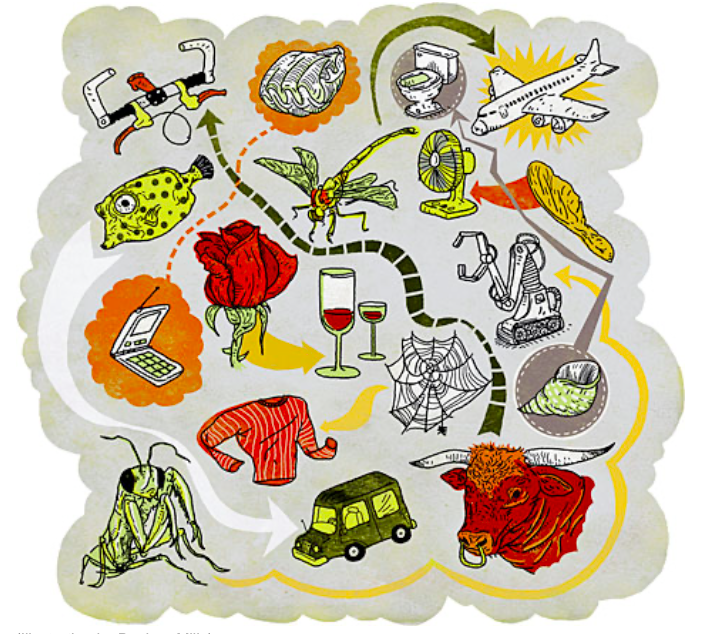
Nature Inspiring Green Design for Planes, Trains, Autos & More
POPULAR MECHANICS | As one group of Boeing engineers recently discovered, the growing field of biomimicry means finding the answers to tough industrial design challenges way outside of the lab.

FIRST PUBLISHED IN POPULAR MECHANICS, OCTOBER 2008
An airplane systems engineer, a shower designer and a biologist walk into a Costa Rican rain forest.
“This is the neatest thing I’ve found this week,” says the airplane engineer, from Boeing, pointing to a cluster of daddy- longleg spiders gently oscillating on the trunk of a banana tree. “There must be some unique muscular elastic element in their legs sensing vibration and amplitude. There could be really important opportunities here for a low-energy sensor or mechanical actuator system.”
The group ambles on, stopping next at a 150-ft.-tall ajo tree with weeping vines and thick buttresses—the kind you might see in a natural history museum diorama. “These roots are circumferentially distributed, so the tree’s strong in any direction,” notes the shower designer, from Kohler. “These buttresses also have a nice gradient to the ground. When we want to reduce stresses in mechanical design, we try to gradually transform one shape into another—nature’s already done that here.”
This observation—that the natural world has spent 3.8 billion years honing elegant solutions to life’s toughest engineering challenges —provides the framework for the growing field of biomimicry. Inventors have long drawn ideas from the world around them. Now, advances in fields like nanotechnology allow them to probe natural processes more deeply. Armed with this insight, and motivated by an interest in sustainable design, engineers increasingly look outside the lab for inspiration.
To develop strategies for converting sunlight into clean energy, some researchers are studying photosynthetic bacteria. Others are examining how abalones, which build layers of calcium carbonate into extraordin-arily strong shells, might lead to a new generation of ceramic composites. Often, the natural model is there all along; it just requires taking a closer look: University of Exeter researchers recently discovered that reflectors used in new, high-emission LEDs serve a nearly identical function as the fluorescent patches on the wings of African swallowtail butterflies.
This past April, Boeing sent three of its engineers to Costa Rica’s southern Pacific coast to learn how biomimicry might be applied to aviation. The team chose to address a chronic problem with flying: the noise. Sound enters an airplane cabin from various sources— the engine, the air flowing across the aircraft, even the stow bins. Fiberglass blankets in the plane’s walls insulate passengers from both the bitter cold outside and some of this noise, but adding more would make the plane too heavy. Eliminating too much noise is also not ideal—consider what it would be like to hear the passengers’ every sneeze and cough.
Led by biologists from the Montana-based Biomimicry Guild, a consulting firm that also works with companies such as Nike, Interface and General Electric, the engineers are spending a week learning how to, if not exactly find the answer, at least ask the right questions. Thinking outside the standard academic toolbox is not intuitive for most engineers, says Dayna Baumeister, the guild’s co-founder. “Putting them in a rain forest brings them back to that childlike state of wonder and suddenly broadens their perspective to other ways problems might be solved.”
That principle seems to be at work the morning the Boeing engineers sit around a picnic table at La Cusinga, a lodge perched spectacularly on a bluff at the edge of a coastal rain forest. Behind them stretches the Pacific, where earlier the group kayaked through a maze of mangrove trees, contemplating desalination strategies.
“Whose survival depends on managing noise or vibration?” Baumeister asks them. “Parasites living on cicadas,” someone answers.
“Howler monkeys.”
“Spiders.”
“We have to look at the champion adapters,” Baumeister says. “What’s their secret? Let’s see if we can figure that out.” She begins reading an academic paper off her laptop. “This is really cool. Leaf-cutting ants produce high-frequency vibrations with a specialized organ. The high vibrational acceleration of the mandible appears to stiffen the material to be cut.”
“So by inducing a vibration into material you can change the physical properties,” muses engineer Bill Sanford. “Including conductance, possibly. Why don’t we change the conductance of the fuselage by shaping vibration to modify those values?”
The group continues to scan scientific abstracts. Cicadas and some birds, they learn, can actively shape the noise they generate— using mechanisms that could be valuable for managing airplane sound. A finding that bees are able to dampen sound by orienting their honeycomb a certain way proves compelling, too. In airplanes, the honeycomb shape is attractive for its high strength-to-weight ratio and so is used in many interior components. But it is currently oriented in a way that may help propagate sound, rather than deaden it.
One afternoon, the group snorkels around a nearby reef. Underwater, they hear a popping sound that calls to mind a child jumping on plastic Bubble Wrap. The source turns out to be a pistol shrimp, which deters predators by creating and then loudly collapsing an air bubble using a specialized claw. It remains unharmed by the noise, they later learn, because its brain blocks specific frequencies, effectively reducing the sound it perceives—not quite a noise-canceling headphone, but an intriguing strategy.
The outing inspires the engineers to look more closely at fish as well. The discovery that body slime not only helps reduce drag but also reduces the vibrations caused by passing waves has the group riffing on ways to modify an airplane’s outer coating to help attenuate sound.
Spiders, which are ubiquitous in the corners of the cabins and on trails around the lodge, also catch the engineers’ attention. Research reveals that they weave various thicknesses and levels of tension into their webs—both for structural reasons and so that the vibrations induced by an arriving meal will indicate what and where it is. If Boeing could pinpoint the places on an airplane’s panels that vibrate the most, the group reasons, they could build a complementary dampening structure on those nodes to minimize the vibration coming from them.
As they brainstorm ideas, Baumeister presses them to consider the fundamental principles behind each natural design. “Does it use benign manufacturing or water-based chemistry? Free energy? Is the system decentralized and distributed, with built-in redundancies?”
While the concepts that Boeing comes up with may be far-fetched in the real world of aviation, they are a start. “The difficult part will be making the transition from theory to practice,” says engineer Heidi Kneller. “But anything that not only encourages a new way of thinking but also opens up a new world of possibilities is a valuable tool.”
On the same trip, two engineers and a designer from Kohler grapple with the more universal, but no less perplexing, conundrum faced by eco-conscious bathers: In a world of water scarcity, how can the indulgence of taking a shower be reconciled with water conservation? The team flips through animal flash cards—the kind that pair a picture of the creature with an interesting fact about it. Soon, they are discussing the ability of whales and dolphins to release millions of tiny bubbles underwater from their blowholes. “Perhaps this unique method of inducting air can supplement water in a low-flow showering application,” one of the engineers notes.
After two days the Kohler team has made serious headway on designs for a low-flow luxury product that the company thinks it can actually develop. And by the end of the week, engineer Pete Kajuch finds himself rethinking the way he approaches design challenges. “Now I reach for a whole new set of inspirations,” he says. “I gravitate toward sustainable design first; I don’t just reach for the same metal and plastic.”
Back at Kohler’s headquarters in Wisconsin, a workroom has been filled with ecology books and displays. While the company can’t send every design team to Costa Rica, it hopes to re-create the effect of immersing them in a rain forest. After all, it sees the value in biomimicry—and how studying a tropical downpour could actually lead to the perfect shower.
Suriname, A Tranquil Caribbean Melting Pot
SAN FRANCISCO CHRONICLE | Sleepy city is a mishmash of cultures, languages, creeds, yet it lacks spice.

FIRST PUBLISHED IN SAN FRANCISCO CHRONICLE, DECEMBER 7, 2018
I step out of my guesthouse the first bright and humid morning in Paramaribo, still holding Suriname as a fantasy formed by alluring snapshots and brief descriptions, like an Internet date I am meeting for the first time.
First impressions call to mind previous encounters. The sight of a roti bread shop housed in a white colonial building conjures the memory - if not quite the manic energy - of New Delhi. The sound of Afro-Caribbean music beating out of a Chinese-owned DVD store - New York, perhaps. I am on the northern fringe of South America, but nobody is speaking Spanish. This is unique. I continue to walk.
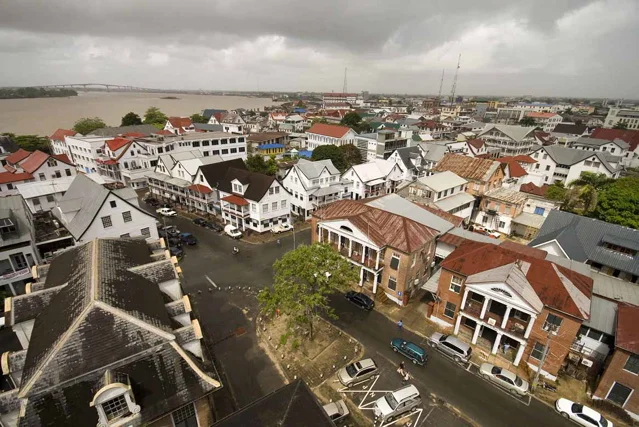
Handsome, 18th century brick-and-clapboard Dutch Colonial townhouses with balconied facades, preserved as a World Heritage site, line narrow streets freshly stained from a tropical shower. I emerge from the capital's historic downtown onto the Waterkant, an esplanade with food stalls along the muddy Suriname River, where Indian families eat Javanese bami noodles and Creole men sip their first of many Parbo beers under the shade of weeping tamarind trees. The heat is rising.
Down the street, merchants, hustlers and loiterers drift between the neon-lit casinos and gold exchanges that surround the boisterous Central Market. Inside, broad women in colorful African head wraps use long Chinese string beans to shoo flies off displays of bananas, rambutans, and medicinal barks.
I pass a dark-skinned Creole man with a shiny set of gold teeth who is selling cups of shaved ice with an array of flavored syrups. His wooden pushcart is festooned with - among other random items - plastic pink roses, Surinamese and Chinese flags, a framed poster of Orlando Bloom's elfin character in "Lord of the Rings," and the words "Snoop-Dog Bless!" scrawled in red paint.
The ices taste OK, but are better as a metaphor. Suriname - a nation smaller than Washington state, much of it uninhabited jungle - is home to 480,000 people who speak more than 15 languages.
Dutch is the official one - the tongue of lawyers and ministers, and friends who consider themselves educated - but if this cart's decorations are any reflection of where most Surinamers currently look to in the world, Holland is conspicuously absent. English is also widely spoken, beamed with "American Idol" into thousands of living rooms each week. But the lingua franca is Sranan Tongo - a hybrid of English, Dutch, Portuguese and West African words that best reflects the Babel that Suriname came to be.

Much of that story is a familiar colonial tale. Natives encountered strange Europeans (first the British, then the Dutch, who gave the Brits Suriname in exchange for Manhattan, thus ending in 1667 the Second Anglo-Dutch War). The colonialists imported slaves (from Africa) and indentured servants (Indians, Chinese, Indonesians). Independence was eventually achieved (in 1975), and power struggles followed (20 years of them, give or take).
But the denouement is unique. Descendents of all these multiethnic settlers still remain - Arawak and Carib Indians inhabit the coast, Maroons live in inland jungle communities founded by the escaped slaves, and pasty Dutch tourists pedal bicycles around the capital - to form an ethos of ethnic tolerance of which Surinamers proudly boast.
From the Central Market I stroll up Jodenbreestraat to reach a symbol of this remarkable pluralism. Neve Shalom, a wooden synagogue built in 1835, occupies a plot of land next to a towering, modern mosque, the largest in the greater Caribbean. Stately white columns give the synagogue the appearance of an antebellum mansion in the tropical sun.
Caretaking a tiny, adjacent museum, 61-year-old Lilly Duym represents the legacy of the Sephardic Jews who sailed from Portuguese Brazil in the 1660s, fleeing intolerance, to establish sugarcane plantations up the Suriname River.
(One day I took a guided boat trip to see Jodensavanne, their once-thriving colony, though all that remains are stone tombstones etched with names like "da Costa" and the original synagogue's brick foundation. Imagination must construct the rest: the Sabbath worshipers mouthing prayers over a din of cicadas still audible today, the breeze shaking guavas off trees into the hands of playing children.)
Lilly receives me warmly, then launches into a veiled call for help. One of the oldest existing Jewish communities in the Americas, she tells me, today a dwindling diaspora of around 125 people, is becoming a historic relic. Another old synagogue a few blocks away is now an Internet cafe and computer repair store; its ritual objects occupy a glass display case in an Israeli museum.
To Lilly I seem to represent the Jewish world that barely recognizes Suriname's existence. She invites me to a Passover seder to be held later in the week, where I can mingle with more of the community.
"They'll be nice girls there!" she adds as I leave, proving that Jewish grandmothers are an international breed.
For all of its polyglot flavor, Paramaribo, surprisingly, lacks spice. By 5 p.m. weekdays and for much of the weekend, the greater downtown merely whispers. Sightseeing in the city is practically limited to Fort Zeelandia, a 17th century brick fortress built by the British on the bank of the Suriname River that also houses a small cultural museum, and aging sugarcane plantation homes in the Commewijne district on the opposite side. Suriname may be one of the few countries in the world without a single movie theater.
I discover some action early one Sunday morning at Independence Square, the country's administrative heart, which is flanked by 200-year-old brick ministry buildings and the white Presidential Palace.
A few dozen men holding birdcages are gathered in the grassy oval plaza. A tiny songbird is a Surinamese man's best friend, a tender bond rooted not in male sensitivity but in an economic reality - a well-trained bird commands a street value of several hundred dollars. Every morning, men across the country can be seen ritually hanging birdcages in front of their homes; many also take them to work. A few admit that their fidelity to these birds, upon which they shower both attention and wages, does cause some marital angst.
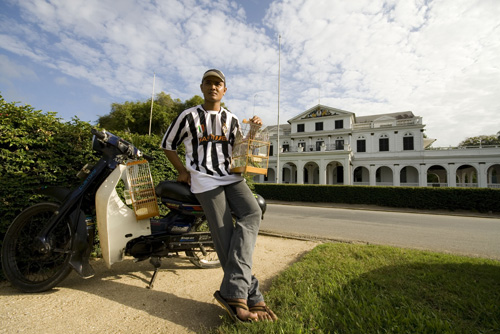
Every Sunday, they hold competitions. It must say something about the temperament of a country when its men gather recreationally to encourage birds to out-chirp one another rather than, say, stage cockfights. On the grass, cages hang from metal posts planted 10 feet apart; beside them stand judges, with strained looks on their faces and chalk poised, striking notches on chalkboards after every squeak or whistle a bird makes. Basically, the bird with the least stage fright wins. To loosen any inhibitions, owners present their male competitor with an enticing female just before show time. This seems to work.
Two days later I am in the sanctuary of Neve Shalom, not a songbird in sight, but still singing. The floor is sandy, a feature typical of Caribbean synagogues that harks back to the Inquisition era when Jews had to pray furtively. The pews are a dark mahogany, arranged behind white columns around the perimeter of the space, underneath a balcony where women traditionally sat. Brass chandeliers dangle over the middle of the floor, where three men are leading prayers from a raised, carved wood bema. The simple but elegant decor as well as the atmosphere, reverent but hardly orthodox, reminds me of a New England Quaker meeting house.
The 70 faces around me - colored dark brown to white - reveal the story of Suriname's four-century-old Jewish heritage, as well centuries of intermarriage. The legacy of the early Jewish settlers, though having a modest presence today, is deeply embedded into modern-day culture. Sranan Tongo includes words of Hebrew origin, like treef (forbidden food); the unofficial national dish, pom - a baked casserole made with a local root vegetable and chicken - that was introduced by Jews.

I had wished that the seder dinner would feature some of these old Jewish recipes, but when we sit down at banquet tables in an adjacent building after the service, it seems that the food is standard communal Jewish meal fare, down to the Manischewitz. I might as well have been in a suburban New Jersey Jewish Community Center.
I sit beside a family of Dutch and Spanish background, an Israeli who is in the country on business, and an American Peace Corps volunteer, who is stationed in a Maroon village an hour from the city, where he teaches English. He tells me that he discovered that some Maroons there still light candles on Friday nights and observe Jewish mourning customs, unwittingly inherited from their ancestors' Jewish masters. (The scene here - a ritual meal celebrating the Jews' exodus from Egyptian bondage, in a country settled by Jews also fleeing persecution, who then promptly became slave owners - has a tinge of irony.)
We sing a few familiar Passover songs after the meal, and by 11 p.m. the crowd begins to thin. I say goodbye to Lilly and her family before walking outside into the humid night. Chandeliers from the synagogue's sanctuary next door still glow softly behind high windows. I walk toward home down the middle of the still and quiet street, past stately mahogany trees that throw pools of shadow across the uneven pavement. A few stray cats cruise along the sidewalk and two night watchmen lounge at their posts, a faint hum of music drifting from the portable radios beside them.

Bloodless bullfights animate California's San Joaquin Valley
LOS ANGELES TIMES | Matadors use Velcro to mark their conquest in the Central Valley, where Portuguese and Mexican immigrants continue their bullring traditions—minus the blood.

FIRST PUBLISHED IN LOS ANGELES TIMES, JULY 29, 2007
The well-coiffed Portuguese matador, muttering provocations in his native tongue, sizes up his weighty opponent's slavering mouth and sloping horns.
In his hand he flashes his weapon: a bandarilha tipped not with razor-sharp darts but with nonlethal Velcro. The bull makes no distinction.
Spectators' voices drop to murmurs. Overhead lights sparkle off the matador's gold sequins, and the smell of linguiça (sausage) perfumes the dusty air. This suspended moment could be a summer night in the Azores -- until the matador lurches toward the advancing beast and, with a graceful twist of his body, artfully sticks the strip of Velcro between the bull's shoulders. A brass band launches into a triumphant score, and I join 4,000 aficionados in an eruption of "¡Ole!" that rocks this creaky bullring in the San Joaquin Valley.
On Monday nights, between March and October, Mexican and Portuguese performers routinely headline "bloodless" bullfights in the nine or so bullrings in remote Central Valley hamlets such as Riverdale, Thornton and Stevinson.
The events are a legacy of the early rancho days, from the Spanish tradition inherited by Mexican settlers. In 1957, California banned gory bullfights but did allow supporters -- mostly Portuguese dairy farmers from the Azores, where the sport is popular and bloodless -- to continue the tradition as long as the bull isn't harmed or killed, and contests were staged in conjunction with religious festivals.The Velcro adaptation was introduced in 1980by Dennis Borba, an American-born matador whose father, Frank, was one of a few pioneering immigrants to revive the old-world spectacle in the 1960s. Their innovation was a unique hybrid that combined the horseback fighting central to the Portuguese tradition with the on-their-feet matadors in the Spanish style.
The fights remained amateurish until local ranchers began crossing domestic cows with Mexican "brave" bulls. Then came the Velcro, for new-world sensibilities.
Curiosity drove three friends and me up Interstate 5 to Gustine last fall on the concluding night of Our Lady of Miracles Festa, the year's largest Catholic celebration. During the weekend, cow-drawn cart parades, folk dances and communal feasts had transformed the sleepy, tree-lined streets of this agricultural town of 5,300 into an Azorean carnival.
The Praça de Touros is on the outskirts. When we arrive, the dirt parking lot is full and cars stretch down the adjacent alfalfa field. The scene is more wedding reception than pregame tailgate: Couples are shuffling to slow, Portuguese ballads on a makeshift dance floor outside; reunited friends mingle and gossip, snacking on traditional food, such as pregos (pork sandwiches), from a wooden stand.The plain, maroon-colored siding around the ring lacks any sign of corporate sponsors or advertisers. In the tiered stands, we take seats next to five, convivial sisters in their 60s, who had convened from points across the state for a night out.
The evening happens to be Sept. 11, and so the fight begins with a patriotic commemoration led by the mounted Merced County Sheriff's Posse, a reminder of the country we are in.. The first act features cavaleiros, men renowned for their agile horsemanship. Luis Rouxinol, regarded as one of Portugal's best, trots into the ring on a handsome quarter horse, outfitted like one of the Three Musketeers in an embroidered, 18th century-style frock coat, ruffled shirt and a triangular, white- feathered hat. He dances his horse around the ring for us to admire its technical prowess, offers his hat to a dignitary and signals his readiness to fight.
The bulls in these corridas -- six in each fight -- have been bred for this moment. After tonight, most are retired to the rodeo -- or the slaughterhouse. Rouxinol's challenger bolts into the ring, disoriented.The cavaleiro steers his stallion toward the excited animal, provoking a brief chase designed to study the bull's movements and display the steed's skillful evasion of its piercing horns, which have been sheathed in protective leather. After a few of these runs, Rouxinol stops to face the bull, pauses and raises a tasseled, Velcro-tipped lance. The bull charges, the horse mirrors the advance, and the two head on a collision course until the horse makes a last-second sidestep around the bull, enabling Rouxinol to angle the bandarilha squarely onto the bull's shoulder.
Act 2. Bugles herald the arrival of eight men who climb into the ring dressed as a cliché of a French waiter: red, bolero jackets fit snugly over white shirts and red ties; tight brown knickers meet white, knee-high socks. Single file, they steadily advance to within 10 yards of the bull, while the lead man - - who wears a floppy, green elf hat in a style descended from Portuguese fishermen -- hollers, "Toiro, oi!"
Because the ring announcer is speaking in Portuguese, my friend Emmet asks a neighbor, a lifelong fan of the bullfights, what people call this group of jesters. "Stupid!" the man says with a laugh, and takes another gulp of beer.
They're actually forcados, named after the pitchfork the men traditionally wielded to protect attending royals from an errant bull. Unique to Portuguese bullfighting, this group from Turlock is known as the Suicide Squad -- and indeed what follows could have been a scene from the movie "Jackass."The bull, now provoked, drops its head and charges the lead forcado. The crowd gasps. The forcado leaps on top of its broad shoulders and grabs its neck in a chokehold. His comrades rush to smother the animal in a rugby-like scrum.
As they subdue the bull -- and the arena crowd goes berserk -- the eldest forcado grabs the animal's tail and digs his heels into the dirt like a water skier.
The others release the bull and saunter off, leaving it to spin madly for its tail, while the forcado tries to hold steady. Perhaps realizing the futility of this circular chase, the bull eventually collapses into the dirt like a sprawled cat -- a symbolic death.
The forcado drops the tail and takes a few steps away before stopping to glare emphatically over his shoulder at the vanquished animal.
Raucous laughter around me overwhelms any sympathy I may have for the bull right now. A herd of bony cows trots into the ring clanging bells, and the bull instinctively rises to join them -- departing into retirement alive, perhaps, but thoroughly emasculated.
Rouxinol and the elf-capped forcado walk the perimeter of the ring like victorious sprinters, receiving caps and wineskins from the crowd, before stopping at the VIP section to accept a bouquet of flowers from the teenage festa queen.
At this point, our neighbors are offering us beer and sausages, and Emmet is on his feet, hands above his head, leading the sisters and the rest of our section in the wave that rounds the arena. The intimacy is something between a rodeo and a minor league baseball game. But rather than grumblings about stray pitching, the prevailing chatter is of lame bulls.
This sentiment is palpably heightened at the beginning of the third, and final act, as matador Vitor Mendes takes the ring. His glowering adversary enters and immediately charges one of the assisting banderilleros, whose function is to test the bull and allow the matador to study its movements. The banderillero finds safety behind a wooden barrier, but the momentum causes the bull to flip over the barrier wall around the ring and into the corridor where the performers stand.
Bystanders jump into the ring as the bull barrels wildly down the corridor past the front row, inciting pandemonium. Our pulses racing, we feel, for a moment, the sport's interplay between artistry and mortality. Indeed, a woman behind us says she has seen two matadors die in this ring.
Handlers redirect the bull back into the ring, and the matador dances an elegant pasodoble with the animal, striking dignified poses with his red cape through which the animal passes, as if it had been staged.
For the Portuguese American community, the bullfights have become a social nucleus and serves to preserve a distant cultural heritage. Back in the Azores, romances are often kindled at these celebrations.
Here, after the main event, the pulsing dance floor outside becomes a cobblestone plaza in the old country. Teenage boys cluster on the perimeter, scoping girls; their parents mingle in the background.
It's a tempting finale -- but we have a long drive home.

The Shaman Is In
UTNE | A tiny Amazonian village mixes traditional healing and modern medicine.

Courtesy of Amazon Conservation Team
FIRST PUBLISHED IN UTNE, SEPTEMBER 2007
At an intertribal gathering of shamans held last spring deep in Amazonia’s northern fringe, a stout elder from Brazil’s Waura tribe offered an impassioned plea. “Please,” he urged fellow healers from Colombia and Suriname, “don’t let the medicine die.”
His appeal did not fall on deaf ears. In Kwamalasamutu, Suriname, where the shamans convened, an innovative model is leading the effort to preserve centuries of indigenous medicine by integrating traditional and Western practices into a thriving community health care system.
The cooperative nature of the effort is evident across the soccer field from where the shamans gathered. In a concrete building, a former missionary organization provides free primary health care, while next door, in a thatched-roof clinic, shamans wield medicines brewed from leaves, vines, and tree barks.
Five mornings a week, villagers trickle into the traditional clinic seeking remedies for a range of common complaints, from yeast infections to diarrhea. The shamans might look at the tendons of patients’ fingers or peer into their eyes before turning to the bottled elixirs they keep in a solar-powered freezer. Or the shamans might refer them to their neighbors for treatment.
So far, three other rural villages in southern Suriname have built similar clinics, replicating a cost-effective model for indigenous health care that’s been hailed by UNESCO and the World Bank and was one of 10 finalists this year for the prestigious Seed Award for innovation in local sustainable development.
The project was conceived by the Amazon Conservation Team (ACT), a Virginia-based organization that partners with tribes in Suriname, Colombia, and Brazil to preserve traditional rainforest culture as a means of saving the rainforest itself. In ACT’s view, those fates are intrinsically linked: If the value indigenous cultures place on their ancestral land, culture, and resources erodes, so too might their will to steward the forest.
When ACT’s founder, Mark Plotkin, first visited Kwamalasamutu in the early 1980s, shamanism was in remission. Missionary trailblazers had collectivized several dispersed tribes into one village, under God. Gym shorts replaced breechcloths. American evangelicals’ pills displaced faith in traditional medicine, and many shamans publicly renounced their practices.
Plotkin, then a Harvard researcher studying indigenous healing, spoke with the shamans and explained to the tribes that many of the white man’s medicines were derived from plants within their own forest. (The World Health Organization, or WHO, estimates that one-quarter of modern medicines are made from plants that were first used traditionally.) In 1988, after several visits, Plotkin presented a 300-page manuscript to the villagers’ chief that inscribed, for the first time, generations of medicinal knowledge. Holding the only book to have been written in the Trio language other than a translated Bible, the chief pledged to pass its contents on to future generations.
To institutionalize that effort, Plotkin helped the village create a shamans and apprentices program with stipends from ACT. Today, a hierarchy of senior and junior shamans oversees a handful of younger apprentices who shadow elder healers in the clinic and on trips into the forest to collect plants. Twice a week, schoolchildren gather next door to the clinic for lessons on plants and handicrafts.
The revival of traditional healing practices comes as cutbacks in government subsidies and spiraling costs have limited the reach of primary health care in Suriname’s rural interior. Operating symbiotically, the two clinics have helped to fill the gap. Joint workshops inform the Western- trained caregivers about indigenous concepts of illnesses, and shamans learn about preventive health practices. They often refer patients to each other. For instance, villagers who show up at the Western clinic suffering from the parasitic disease leishmaniasis will be sent next door to the shamans for an ointment that’s more effective than any modern tincture.
“It’s not some mash-up where you’ve got shamans handing out antibiotics,” says Plotkin. “It gives [locals] a lot more free choice than I have with my health plan and has demonstrably reduced the expense for outside medicine by 20 to 50 percent.”
The clinics’ practices are also helping in a larger effort, pushed by the WHO, to develop stronger evidence of traditional medicine’s quality, safety, and efficacy. The clinics in Suriname have begun keeping records, and pharmacists there have introduced shamans to standardized measurement methods for collecting, preparing, and storing their medicines—efforts that will shed light on their efficacy and facilitate the production of medicines. They’re now experimenting with more user- friendly (and potentially marketable) forms, such as a dry tea bag.
Ultimately, though, the broader intention of the program, explains Plotkin, is for tribes to find their own answers to some pressing questions: “How do we interface with Western science? What are we willing to share? ...And how do we take an approach that benefits our culture, our forests, and, in the end, everybody?”
ALL'S FAIRE IN NOVATO
SAN FRANCISCO CHRONICLE | 'Rennies' find comfort, camaraderie in bringing Queen Elizabeth and her era to life each year.

Photo: Deanne Fitzmaurice
FIRST PUBLISHED IN SAN FRANCISCO CHRONICLE, AUGUST 5, 2005
'Tis noon and the village is buzzing. Word on the street here is that Queen Elizabeth is hunting in the countryside nearby, soon to make a rare appearance.
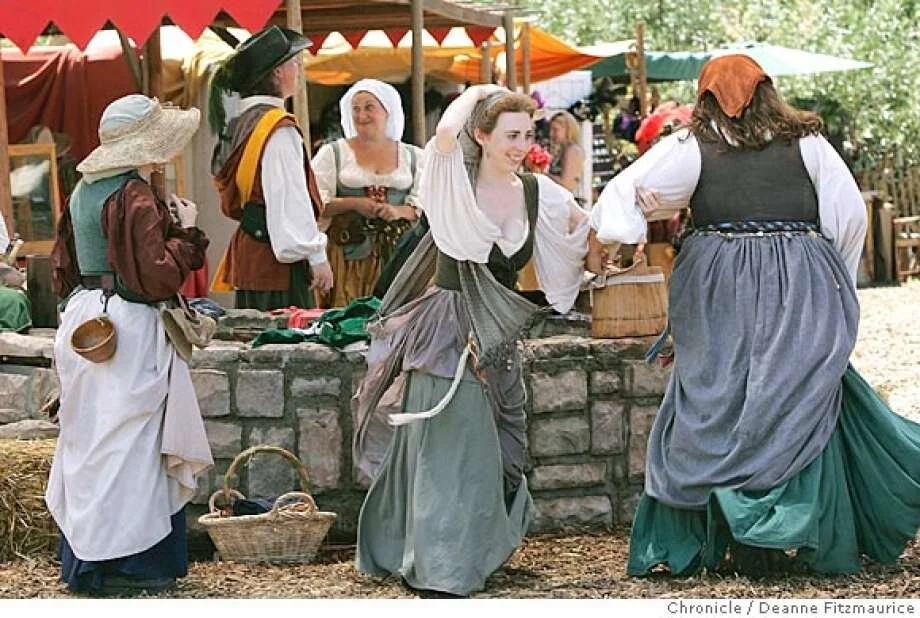
The peasant women cluster around the washing well and slap dirty linens against slabs of stone as they gossip with passing musicians. The tapster fills his patrons' pints of ale and glasses of mead at the Mermaid Tavern on Potwobblers Way. And farm folk seek reprieve from the searing 95-degree midsummer heat under a sprawling oak.
The year could be 1575, in a hamlet outside Stratford-upon-Avon, England. Actually we're in Stafford, a county park outside Novato, and it's 2005.
For six weekends every summer, the Heart of the Forest Renaissance Faire recreates a "lusty Elizabethan country fair" in a meadow alongside Stafford Lake, replete with period food, period actors in period clothes talking with period dialects (known as BFA, or Basic Faire Accent, taught to would-be participants three weeks before the event).
For most of the 2,500 average daily visitors, the fair is a throwback in time, which is exactly the point. Great pains are taken to create a seamless environment devoid of modern-day reminders.Woodchips and straw line a path that meanders through the midsummer market site, past booths with merchants hawking handmade crafts, food stalls, games and stages where Elizabethan theater is performed. Jousters fight, jesters frolic, minstrels sing and mayhem ensues.
But for participants, this fair is more than mere entertainment. Many of them first came as visitors but were compelled to return year after year as actors. Now they're part of a subculture with its own distinct language, rituals and code of conduct.
"Rennies" (a term for a participant used in some Renaissance fair circles across the country) share something with Trekkies, the quirky fans of "Star Trek" who wear uniforms, form communities and meet regularly at conventions. Both play with time -- one venturing into the future, the other into the past -- and and both satisfy people who don't quite identify with mainstream pop culture.
Organizers say that what partly draws people to the fair is a deep, unconscious, even primal connection to our pre-modern, agrarian roots and the days of seasonal festivities.
"The fair is like time traveling safely," says a peasant woman in her mid- 70s, wearing a flower-decorated straw hat atop braided pigtails. "You know you can get back."
The peasant is Phyllis Patterson, who conceived and created the original Renaissance Faire in Los Angeles in 1963, and later at China Camp in Marin County in 1967.
Patterson had been teaching summer theater history workshops to children in Laurel Canyon in Los Angeles in the early '60s. Among the kids, a popular facet was a form of "guerrilla" theater from the medieval period that featured traveling actors in mobile carts performing in village markets. Patterson decided to recreate an entire medieval market that these traveling actors would have encountered -- where "all the fair's a stage."
She wanted the fair to be a benefit for the nascent listener-sponsored Pacifica Radio and met with members of the station's board to pitch the idea. One of the board members, a hardheaded ACLU lawyer embroiled in contemporary civil rights issues, didn't want to have anything to do with a "Middle Ages" fair, believing -- incorrectly -- that the period didn't engage the concept of civil rights. Patterson relented, and put forward the idea on the spot of recreating the Golden Age of the Renaissance instead -- basically, bumping up the setting a century or two, a more memorable time for theater, anyway.
And the rest is, well, history.
Patterson's fair spawned a national movement. There are now at least 115 Renaissance fairs in North America, mostly independently owned and operated. Alhough her idea has taken off, Patterson questions the historical authenticity of most of these fairs.
"They should probably get their own name for what it is and not just use 'Renaissance' as a buzzword when they're not any different from a Disney-like theme park," Patterson says. "I'm not pleased to have inspired very bad versions."
Dozens of Web sites and newsgroups, such as renfaire.com and alt.faires.renaissance, have cropped up in the virtual age, binding enthusiasts around the country into tightly knit communities outside of fair dates. Participants in the Marin fair attach themselves to guilds -- specialized performance troupes -- and stay in touch throughout the year.
Knife maker and potter Jon Schulps has been touring Renaissance fairs for 35 years. Schulps, stationed in a hand-built booth at the foot of Potters Row, is something of a Renaissance man himself. After studying architectural design at UCLA in the early '60s, he was drafted by the Minnesota Vikings and played as an offensive tackle before being drafted again, by the Marines, and sent to Vietnam.
When he returned, he found he wasn't interested in playing pro football anymore, so he poured energy into his craft. A friend turned him on to Patterson's fair in 1969. After some initial skepticism ("I didn't know if I could get along with those people, but then I saw that it wasn't a bunch of crazed-out hippies"), he made it a steady outlet to sell his wares.
Schulps has crafted period knives for Hollywood blockbuster movies such as "Braveheart," but his cash cow has always been Renaissance fairs.
"It reconnects me with artists," he says. "We help each other out."
Patterson's son Kevin agrees. He was practically born into the fair, and now at 45 directs the Marin and Lake Tahoe Heart of the Forest Faires, along with the Dickens Christmas Fair in December, which transforms Daly City's Cow Palace into a wintry London cityscape.
"People find there's this sense of community, safety and comfort," he says. "I can walk up to a stranger here and say 'Good morrow, sir!' unlike in downtown San Francisco. We're like an extended family that gets together for more than just Thanksgiving," he says, standing near a vendor selling huge turkey drumsticks.
"There's a certain level of geekiness attached to this," says Paul Jennings, a part-time receptionist at LucasArts in San Rafael who plays Sir Walter Raleigh, complete with a steel helmet, homemade blue velvet outfit and leather boots. He sweats heavily under the blazing sun.
"Like any other sort of fringe activity, you find that people are attracted to it because there's something that it fulfills that their daily life doesn't," Jennings says.
"One of my personal favorite moments in life was when a buddy of mine and I were working in the joust," Jennings says. "We finished up one really hot day, went over to the Rosie Stag, a little on-site period tavern, clapped our swords on the table, ordered up a pitcher of ale, whipped out our period pipes and tobacco, and just sat there relaxing for the next hour waiting for the next joust. Moments like that, you feel like you've transcended into what (life) might have been at that time."
As the afternoon marches on, a group of militiamen wielding halberds -- long poles tipped with an ax head, all the better for hooking someone off their horse -- strolls down Potters Lane. In modern times, they might be called Secret Service agents, but their reconnaissance here provides the keen observer with the first clue that Her Majesty is approaching the village.
"I'm an escapist, and this is fantasy," says Bill Hewitt, a handyman and sci-fi movie fan from Martinez. During a 19-year tenure, which started when he began taking his daughter to fencing lessons at the fair when it was still at Blackpoint, he has worked his way up the ranks of the queen's guard. His daughter has since moved on.
"There is too much drama in real life, so this is a bit of an escape," Hewitt says.For many, that escape is toward a creative outlet their professional lives lack. The majority of participants seem to work in information technology.
"In the very beginning, all the members of the Queen's Court worked as programmers for Apple Computer," says Patterson, "and the peasants were data processors."For others, the fair provides a venue to leave behind, if only for some hours, the expectations modern society places on them.
"I like being a peasant very much because I can grovel in the streets to my heart's content. I can be dirty; I can be crude," says a Sebastopol homemaker named Kathy Woeltjen, who adds, "me fair name is Abigail."
"We eat in the street as peasants," she says as she spins wool. "We sit in the dirt. We sometimes have food fights -- these are not things that I would normally be doing as a middle-aged American woman. It's a license to play."
In the culture of fair, that also means the chance to act out anachronistic social norms.
"Chivalry can be great fun, whether you just want to be a little nice to someone or if you want to be a knight," says Patrick Franz, a period actor from Los Angeles who plays Touchstone the Fool and confesses that he has a crush going for the Mistress of Misrule. "It's a chance to treat women like ladies, to take your darling's hand and kiss it, and people don't look at you funny."
The women seem to welcome the change. "You have to make a paradigm shift, " says Aurie Bradley of Kensington, who works in real estate when she's not playing the Countess of Warwick, the queen's lady-in- waiting. "You have to say, 'It's OK for a gentleman to open the door for you.' During your (normal) life you have all these responsibilities, so it's nice to have a vacation.
"We have had cases of people who came to play with us who did have a problem with that," she adds. "They were active feminists and could not deal with pretending not to be, and they don't work out.
Some people just can't make that switch," she says, admitting that she has spent hundreds of dollars and countless hours researching the Elizabethan period, making costumes and visiting her character's tomb in England. A cheap hobby? Nay not.
In other words, you can take the Elizabethan out of the person, but you can't quite take the person out of the Elizabethan. "Our jousters will take this as their living: they live with chivalry and honor throughout the year," says Franz. "If they can get out of their character, they can't quite get out of their code (of honor). Everyone makes their own decisions about how much they get into it."
Rydell Downward, who performs the Earl of Leicester, the queen's favored courtier, though rumors of a possible romance abound, admits his lofty status can get to his head.
"I have a large vocabulary, which rather vexes some people in the modern world," he laughs, speaking in impeccable Basic Faire Accent. "And I think people note something in my bearing that is different than most."
Down the street, two peasant friends, saucy from a day spent carousing at the ale stand, stumble down the street holding one another upright. They sing songs and flirt with passing young women. Whether it's an act or not is unclear -- the line is often blurry at the fair.
"One of the things that attracted me to this was that I was 21 and this place is crawling with women, with an ale stand every 30 feet," says Jennings as Sir Walter Raleigh. "I mean, it was a great time."
Cherry Edwards, who works as an architectural designer and seamstress in Santa Barbara, partly so that she can sew medieval-style tents to live in when she's not "in fair," agrees that the fair can be an ideal setting to form -- and save -- relationships.
"I think the healthiest thing for any marriage or partnership," Edwards says, outlining an ideal fair date, "is for the two to say, 'I'll meet you at 1 for lunch,' separate for the duration of the morning, drink whatever they want to drink, and then go get fluffed by all the lovely, poetic things that people say to each other. Then meet for lunch, see a couple of shows together, and have an awesome time."
Cheers of "God save the Queen!" coming from nearby peasants and the beating of drums interrupt her.
Parading down the street with a regal air, flanked by a royal entourage of guardsmen and distinguished members of the court, Queen Elizabeth comes into view. She stops to admire a young girl, who gazes back with wonderment, and then continues.
Says Edwards, "This is the bright spot of my year, a total shot in the arm. You get this wonderful time to play here -- to get fluffed, and flirted with, and complimented. You get to be in this state of being that you can't be any place else."