
Facing Polar Bears, Isolation, Researchers Explore Arctic Sea Ice
NATIONAL GEOGRAPHIC | Life aboard the icebound R.V. Lance, as scientists study the effect of warming temperatures on the Arctic.
FIRST PUBLISHED IN NATIONALGEOGRAPHIC.COM, MARCH 19, 2015
82.44 DEGREES NORTH—We've drifted across the frozen Arctic for 30 days. Four miles here, ten miles there—a squiggly red line on the ship's digital chart is the only measure of progress.
Trapped in ice, the Lance meanders at the mercy of wind and current. Some days, low, moist clouds engulf the ship from the south; on others, cold northerly winds chill it by 50 degrees. Switched off at this latitude for four months of the year, the sun now rises higher each morning, casting long shadows off surface ice ridges and snowdrifts as it traces a low arc across the horizon.
From January to June, in six-week stints, scientists are on board the Lance, a research vessel operated by the Norwegian Polar Institute (NPI), to study how the ocean, atmosphere, snow, ice, and biology all interact in the Arctic amid a backdrop of significant warming. "Right now we're just trying to take as much as we can, because this is a one-off opportunity to get this data," said Amelie Meyer, an NPI oceanographer. "And nobody's got it."
Isolation has settled in. The Lance is currently some 250 nautical miles from another human dwelling or vessel—farther than the distance between New York and Washington, D.C.
At one point, a polar bear crossed our path, paused for several days to sniff at the weather masts and strange-looking electronic instruments it encountered, and then eventually moved on.
A bioluminescent jellyfish happened by a hole bored in the sea ice one day, drawing excitement: signs of life! The other night, a marine biologist sat elated at her microscope as it magnified a rare glimpse of an amphipod, caught in a net that day from 200 meters (656 feet) below, giving birth to ten offspring.
People refer to life on board as "The Bubble." Snippets of world news leak in through email, via satellite, like communiqués from another planet. What date is it today? Certain things just fade from mind. "It's kind of comforting to not be bothered by all of ordinary life's problems," admitted Algot Peterson, a Norwegian oceanographer. Without smartphones or the Internet, he said, "you actually sit and talk to each other."
Absence of distractions also brings into sharper focus the task at hand.
Each day, worker bees in yellow-and-black jumpsuits drag children's sleds laden with tools and equipment to their study sites across the ice floe. They analyze it from every angle. With a thermometer and a scale, a snow physicist stands thigh-deep in a snow pit, measuring the temperature and density of the different layers of snowpack to discern how much it insulates the sea ice from the cool atmosphere above. A Japanese biogeochemist deploys a robot that traps and measures carbon dioxide emissions off newly formed sea ice, its surface ornamented with delicate bouquets of salty ice crystals known as frost flowers. Nearby, sea ice physicists drill ice cores that they'll analyze for their internal crystalline structure, which holds clues to the environmental conditions under which the ice grew.
Farther below, warm Atlantic seawater, which passes between Iceland and Norway as it enters the Arctic, lies beneath a 100-meter-thick (328 feet) layer of cold surface water. Several times a week, oceanographers send down instruments that probe these layers of seawater to determine how much—and when—they mix, as heat from the Atlantic water influences ice thickness and its extent across the Arctic.
Woosok Moon, a researcher from the University of Cambridge, tries to make sense of all the data. In his cramped cabin on board the Lance, he spends evenings scribbling arcane equations into a notebook, which no one else seems to understand.
Much more than mid-latitude environments, Moon explained, the Arctic sea ice system, especially in the summer, is highly sensitive to any disturbances. As more bright ice melts and is replaced by dark ocean, for example, more solar energy is absorbed in the water, raising temperatures of the ocean and air that in turn melt more ice—a process known as the ice-albedo feedback.But other feedback loops counteract that process. "It's like an unstable person, bothered by neighborhood noise one day, and a gentleman the next. It's very hard to make future predictions about erratic behavior."
Moon is trying to forecast the status of the Arctic sea ice by building a stochastic model, which is similar to the models used to make stock market predictions. It concedes that there are certain behaviors of sea ice that are simply too complicated and too unknown to try to force into a model—how two ice floes located side by side can vary in thickness, for example—but it maintains that with a deep understanding of the basic physics driving sea ice growth and melting, one can narrow the uncertainties enough to make a reasonable prediction.
As Moon sat inside the Lance, 34-mile-an-hour winds swept in from the south. They pushed the ship in the opposite direction of its planned drift back to Spitzbergen, undoing two days of southward progress in a matter of hours. The temperature shot from minus 22 degrees F (-30°C) to 32 degrees F (0°C) overnight, eventually settling back to minus 7 (-22°). The ice floes hemming in the Lance, meanwhile, slowly became unstitched.
First one crack here, then another, the fractures slowly widened until the ship was separated from the various study sites across the floe by gaping channels of exposed seawater, which began radiating smoky vapor. One split took down a 33-foot-high (10 meters) weather mast in the atmospheric science quarter. A GPS station began to drift its own way. There went the neighborhood.
Also, the boat was stuck. The industrious crew spent the next two days trying to dislodge the Lance from nearly 18 feet (5.5 meters) of ice blocks that had nestled under its bow during a storm two weeks earlier. A tranquil week of data collection suddenly turned into an instrument rescue mission. It was time to pack up and abandon the floe—if only the boat could set loose.
Many, naturally, had anticipated such a disturbance. "That's uncertainty," Moon joked.

Dining Room Diplomacy
SALON | As bombs fell on the Middle East, I cooked a gourmet meal for a group of Arab artists -- and between bites of roasted tomatoes and baby lettuce, the world seemed at peace.
FIRST PUBLISHED IN SALON, DECEMBER, 2006
One brisk evening last July, two Jews in Berkeley, Calif., discussed the Tunisian circus with a group of Arab artists over plates of polenta, summer squash and a confit of tomatoes that resembled clowns' noses. The incongruity of the occasion, while fighting engulfed Israel, Lebanon and Iraq, and summer heat blanketed the rest of America, was not lost on the diners. Around the table sat the founder of a clown school in San Francisco, and distinguished guests from Tunisia, Egypt, Qatar and Bahrain, who had arrived by invitation of the U.S government. I was their host.
The scene had overtones of citizen diplomacy. The State Department, among its many missions, is charged with spreading goodwill abroad. Recognizing that this effort is best waged inside the homeland, each year its field embassies handpick hundreds of "current or potential leaders" -- in government, media, education and other fields -- and invite them on a whirlwind tour of America to meet their professional counterparts and experience the country firsthand.
To provide these dignitaries a glimpse into domestic life -- and perhaps, to prove that our culinary heritage is more Wilsonian jambalaya than George Bush freedom fries -- the State Department's International Visitor Leadership Program partners with nonprofit organizations in each city to arrange home hospitality visits with local volunteers. After all, not everyone deserves a black-tie state dinner, but stomachs are a proven route into hearts and minds.
So several times a year my one-bedroom cottage is transformed into something of an international bistro. Last December, I served three reporters from Turkmenistan their national dish, palov, a pilaf with lamb, carrots, currants and almonds. If I could rate my own establishment, I'd say I earned an extra star that night. My guests, appreciative in the way that locals abroad admire even tourists' sputtered attempts at a native tongue, savored the flavors of their home and eagerly demonstrated how Turkmen chefs prepare the dish, mounding rice with the care of a barber sculpting a pompadour. As the evening eased on, we discussed Turkmenbashi, the country's dictatorial leader who has fashioned a peculiar cult of personality. My questions were met with ambiguous, diplomatic reactions. A week later I received an apologetic call from their interpreter: The group, he explained, had been warned the secret police might be tailing them.
A month later I had a more open exchange with the anchorwoman of Shanghai TV, whom I served Sichuan toasted sesame and Napa cabbage salad along with a smattering of Chinese phrases I learned while backpacking through Asia during the SARS outbreak. After a glass of wine, she offered some off-the-record accounts of Chinese media censorship. (The party's ears, she must have reasoned, were safely out of range.) Another evening, in a pinch, I shyly poured "Two Buck Chuck" Shiraz for a prominent Argentine newspaperman who arrived with a hankering for a fine Malbec. "Delicioso," he remarked, as he held up the glass to inspect the wine's legs.
My Middle Eastern guests arrived in July, when the summer's bounty was near peak, and so I decided to offer them a taste of truly local gastronomy. I phoned Chez Panisse, the birthplace of California cuisine, for menu suggestions. Michael Peternell, chef at the cafe, riffed on the possibilities.
Stay away from couscous, Peternell suggested; the risk of presenting an inauthentic version to such discriminating palates was just too great. Instead, for starters, he proposed a salad of Little Gems lettuce, a baby romaine grown locally by Blue Heron Farms, which I could serve with crispy cucumber slices and a creamy avocado Green Goddess dressing. A main course of herbed polenta wedges would follow, mixed with fresh corn kernels, topped with roasted Early Girl tomatoes and grilled seasonal vegetables -- eggplant, summer squashes and cremini mushrooms -- and drizzled with pesto using basil grown in my backyard. For dessert, Peternell proposed peaches, baked with chopped walnuts, butter and brown sugar, and accompanied with vanilla ice cream.
It sounded promising, if laborious. After shopping at the local farmers market, I returned home to dutifully reproduce Peternell's game plan. At 7 o'clock, my aunt Arina arrived, a former clown and stage performer who now uses theater techniques to coach nuclear scientists in compassionate team building. We picked up our visitors, and their Yemeni interpreter, from the train station.
Such cultural exchanges usually begin with the transfer of gifts, followed by business cards. Once, from a Bulgarian journalist, I received a bottle of rose oil; from a senior advisor in Slovenia's education ministry, an embroidered purse. An advisor to the prime minister of Albania once brought a carved statuette of a famed Albanian warrior, which now sits on a shelf next to a pair of traditional wooden dolls gifted by the head of Mongolia's copyright office.
Ahmad, a musician with the Cairo Opera, presented me an engraved glass pyramid from the reopened Library of Alexandria, where he also works as the international liaison. The only other person in the United States who possesses the same souvenir is Laura Bush, he noted, who visited the library last year. Honoring the distinction, I placed the object in the East Wing of my house, a windowsill. I poured glasses of zinfandel, and we migrated into the backyard.
Most visitors coming through the International Visitor Leadership Program have never been to the United States. They arrive, like many foreigners, with a CNN-and-Hollywood-eye view of American society, which can make for an illuminating reality check. Over dinner, my first questions always address these revelations. A visiting Polish journalist once voiced shock over how fat we Americans are, an observation not readily gleaned from the products of America's pop culture factory.
My guests that July night had accumulated some generous impressions: We are very hardworking, helpful and friendly (ironic considering our reputation as foreign tourists), and very ignorant about the world outside our borders. To illustrate how downright American we are, Abdullah from Qatar recounted how he had visited a church in Washington, D.C., earlier in the week, toting a camera, and a couple nearby offered to take his picture "without even having to ask them!" But everyone was surprised to discover that few Americans own passports. Most certainly couldn't name Arab countries on a map. Later in the evening, my comment that Hosni Mubarak was "repressive" elicited a strong reaction: not for my evaluation of the Egyptian president's administration -- which Ahmad flatly refuted, anyway -- but simply because I knew his name.
Whereas Americans are clueless, the Egyptian public "knows everything about the world ... everything," Ahmad claimed assuredly. I thought the widespread belief in absurd 9/11 conspiracies held by this public -- even journalists and intellectuals -- might challenge his assertion, but I held my tongue.
For our collective ignorance about Islam in general, Ahmad blamed American cable news networks for misrepresenting Muslims. I pointed out that unfortunately extremist voices often out-compete the silent, moderate majority on our airwaves. "Yes, yes, you are right," Ahmad said, shaking his head. "It's our problem." The ignorance works both ways, he allowed, and looked forward to enlightening friends back home.
The morning of the dinner, Israel had escalated its devastating bombing campaign against Hezbollah, and Ahmad -- at 35, the youngest in the group -- was impassioned. Naturally, conversation veered toward Middle East politics. "Why are the American people beside Israel, beside Israel ... continuously?" he wondered. America's apparent double standard, reflected in its handling of the Israeli-Palestinian conflict and its stance against Iran's nuclear ambitions, frustrated him. "You are the greatest country, and the strings of the game are in your hand," he said. "Just be fair." Most Arabs today, he added, distinguish between the views of the American people and its politicians, much like they do Judaism and Zionism. But if democracy is supposedly working so well here, why can't American citizens steer Middle East policy toward peace?
Ahmad and I could have compared our differing versions of the history of Jews in the Middle East -- but instead we moved inside to the dinner table, where over Little Gems lettuce wedges, we discussed the arts. Earlier in the day, the group visited San Francisco's Yerba Buena Center. Kathloom, a small, loquacious woman and accomplished actress, filmmaker, choreographer, trainer, director and theater consultant to Bahrain's Information Ministry, was blown away. Arts organizations in the U.S. are essentially nonpartisan entities, with dedicated venues and free range on programming. In Gulf countries, the government retains creative control and funding of the arts, and artists must be recognized by various ministries.
The situation is quite different for the Tunisian circus. Ferid, a soft-spoken, chain-smoking, 54-year-old former lawyer, founded the National Circus Theater three years ago with the help of French trainers. Tunisians, it turned out -- especially Bedouins -- love the circus. Most of his funding comes from their ticket purchases; the rest, from a Coca-Cola sponsorship. In turn, Ferid produces four shows a year awash in Coke branding. For these special performances, the artists' costumes -- ordinarily traditional Tunisian fabrics and colors -- are emblazoned with Coke logos, much like an endorsed tennis player. For one televised production, aerialists and dancers resembled Coke bottles head-to-toe, and as he described it, I imagined a bizarre, "Gods Must Be Crazy"-like scene of lithe soda bottles flying between trapezes in the North African desert.
As Chef Peternell predicted, the tomato confit oozed a flavorful, red juice over the polenta and its seasonal vegetable companions. My guests -- whose culinary expectations of America ended at pizza, fast food and steak -- were delighted. Their reactions sounded like a glowing Zagat listing: "Very nutritious ... my husband will have to cook it!" (Kathloom); "Very good" (Ferid, with an approving nod). "Truly delicious and surprising," announced Ahmad (a compliment I later learned was the only praise he paid American food during his two-week visit).
Dessert was served in the living room. Over baked peaches and French vanilla ice cream, we sipped rooibos tea while Ahmad strummed an oud he'd brought, singing traditional Egyptian melodies in the trilling and seductive vocal style of a muezzin's call to prayer.
"Aysh maana sit alinjiliziah hialli bitrouh alintikhabat/ Wal beit howa bassi gadar asit almasriah" -- "Why can British women vote, while ours are holed up in their homes?"
The lyrics were from Sayed Darwish, a prolific composer who, in the early 20th century, championed modernity and social progress during the era of British occupation. His provocative words have a contemporary relevance, of course; in Egypt today, fundamentalism is gaining support, and with it, an intolerance for the arts competes with the thirst for freedom of expression. "If the Muslim Brotherhood were in power, they'd kill me," Ahmad solemnly told us.
For a moment, the music transported us all someplace else -- to a land where the air is warm and inviting, but sadly, too often filled by instruments of war. Sitting comfortably on my couch, Kathloom and Abdullah smiled and joined in a familiar verse. Arina joyfully clapped along. I added notes on my mandolin. And then, from an open window, a chill crept into the room -- a reminder that this was, and could only be, a summer night on the San Francisco Bay.

How Entrepreneurship Is Helping to Save Puerto Rico
ENTREPRENEUR | After Hurricane Maria savaged Puerto Rico, a man named Jesse Levin used what he'd learned as an entrepreneur and applied it to disaster relief. And it worked.

FIRST PUBLISHED IN ENTREPRENEUR, APRIL 2018
When Hurricane Maria raked across Puerto Rico last September with wind speeds of up to 155 miles per hour, it left a path of unprecedented destruction. The storm flattened houses and forests, flooded towns and made hundreds of thousands of people homeless. It knocked out most of the island’s power grid, leaving nearly all 3.7 million residents in the dark, and severed 95 percent of cell networks as well as 85 percent of aboveground phone and internet cables. Eighty percent of the island’s crops were decimated.
Once the hurricane moved on, an all-too-common aftermath unfolded. Local emergency responders became overwhelmed. There was, memorably, public fighting among political officials -- San Juan’s mayor versus President Trump. Relief agencies and volunteers flooded in. People who wanted to help could find long lists of organizations to donate to, though, as is typical after a disaster, it wasn’t clear where the money was best spent. Dollars often flowed indiscriminately.
Ten days after the hurricane, a different kind of responder arrived on the island. His name was Jesse Levin, a 32-year-old serial entrepreneur with close-cropped hair and aviators, and the co-founder of a series of rock-climbing gyms called Brooklyn Boulders. He had no military background, though he had volunteered in past disaster zones and spoke the language of relief -- casually discussing “air assets” and “force multipliers.” Before he arrived he’d made plans to help, help that didn’t necessarily involve the cluster of government agencies and NGOs that were scrambling to advance their operations. “It was mind-boggling,” he recalls now. “There was just completely ineffective communication going on.”
A rented jeep was waiting for him.
Once in Puerto Rico, Levin spent several days crisscrossing the island’s debris-strewn roads, talking to residents, business owners, mayors and policemen. He rarely came across an aid worker or a utility truck. In the media, he’d kept hearing that people were desperate for food and water. But in village after village, Levin encountered grocery stores open and stocked with enough provisions to sustain the local communities. Enterprising merchants had even rustled up generators to keep on the lights. But many customers couldn’t buy anything: Around 40 percent of Puerto Rico’s population depends on food stamps, which require Electronic Benefit Transfer (EBT) cards to make purchases. With the island’s telecommunications network down, the cards couldn’t be processed. This particular problem didn’t require an intensive governmental effort to distribute food and water. It was just a connectivity issue that nobody else was solving.
So Levin coordinated with Steve Birnbaum, a satellite communications expert he works with, who had arrived on the island a week before the hurricane to prep for the storm’s aftermath. Their plan: to personally buy a bunch of small satellite terminals from Focused Mission, an emergency response business on the island. Levin then worked some local government contacts until he wrangled a helicopter. Among them was Puerto Rico’s chief information officer, Luis Arocho, who came along for a beta test to see if their plan would succeed. Soon this small team was airborne and installing terminals on two grocery store rooftops. They flipped the switches and boom -- EBT purchases now worked. Levin would go on to install 12 more.
The experience was validating. “If the economy is broken in a place, the location can’t heal,” Levin says. But now, functioning EBT machines can lead to more products sold, more employees paid and more shelves restocked -- an economic system revived, and saved from further dependence on FEMA aid. He says the hard costs totaled $33,000, which was ultimately reimbursed by the Foundation for Puerto Rico, and that around $3 million in transactions have since passed through the satellite terminals.
But it was legitimizing on a far larger level as well. Levin isn’t here in Puerto Rico simply to do one-off projects like this. He’s here to advance a concept -- an audacious idea that he calls “expeditionary entrepreneurship.” In essence, it’s disaster relief in the form of entrepreneurship. Governments and NGOs are important, he says, with their standard operating procedures and approaches to administering aid. But entrepreneurship -- not profiteering, but the principlesof entrepreneurship -- can accomplish what those bodies cannot: quick and nimble responses to ground-level problems, and connective tissue between foreign aid resources and capable local actors like grocery store merchants who are often not engaged. The same instincts that help an entrepreneur build a business, in other words, can help them rebuild a region from catastrophe.
Levin explains this to me as we drive past toppled power lines and landslide debris in Puerto Rico’s lush interior mountains. It is mid-January, four months after the storm has passed. “An entrepreneur looks at systems and comes up with creative fixes,” he says. “We start from the bottom up.”

Levin didn’t just dream up “expeditionary entrepreneurship” one day. Instead, he came to it after pursuing two parallel paths: He was an adventurer, and an entrepreneur.
He’s always had an entrepreneur’s sensibility -- that ability to sniff out an opportunity and boldly claim it. As a middle schooler in Connecticut, he launched a guerrilla marketing company called Jesse Levin’s Adrenaline Marketing. (Slogan: “With all due respect, you need a kid.”) He talked the beverage company SoBe into paying him $15,000 and helped promote them at extreme sports events by dyeing his, his friends’ and even his dog’s hair the brand’s hue of green.
During summers, meanwhile, he also attended wilderness survival classes, learning how to build shelters and track animals through the woods. He became captivated by the power of resourcefulness -- how solutions exist all around us. “Survival school informed every facet of my life,” Levin says. “My relationships, how I see things, how I conduct my business.”
After graduating from Babson College in 2007, those two passions continued apace. He moved to Panama, got into real estate, eventually bought a farm, and then launched a consulting firm. A Dutch company hired him to do project management and cultural mediation work in a remote coastal area where it had acquired land. The area -- a haven for narcotraffickers and local mafia -- was prone to flooding, and Levin inadvertently became the go-between for the special maritime police and the Red Cross to deliver medical care and supplies to his local community. The experience got him interested in disaster relief, so he followed the typical path: He volunteered. Following the historic earthquake in Haiti in 2010, he joined the NGO Hope for Haitiand spent six months crawling around the rubble. After the 2013 typhoon in the Philippines, he split his time between Manila and a town named Tacloban, where he worked alongside Team Rubicon, a relief organization made up of veterans.
Amid these overseas excursions, he was also pursuing traditional entrepreneurship. He became co-founder of Brooklyn Boulders, a New York climbing gym that was expanding into new cities. The first location was just outside Boston, and Levin’s goal was to draw people to the space. He realized that the same principles he’d learned in Haiti and the Philippines -- drop in with no agenda, assemble a capable operational team and work closely with locals to find culturally relevant solutions -- could work here as well. “We found the bike builders, the finger painters, the VCs and the nonprofits, and as we built, we said, ‘Here’s our philosophy: How can you leverage this space to amplify what’s going on here locally?’ ” Soon the place became a hybrid gym/community center/co-working space, hosting drone races, TEDx events and nude drawing classes, with MIT engineering students mingling with graffiti artists. Levin would replicate the concept in Chicago, and sell most of his stake in 2016.
Throughout this period, starting in 2010, he also launched and ran a company called Tactivate, which pitches itself as a project manager inspired by the strategies and tenets of Special Operations. Through his disaster work, Levin had befriended many Air Force pararescuemen and Army Ranger types. He found them to be inherently entrepreneurial, but their resourcefulness, wide-ranging capabilities and “operational mentality” often went unappreciated in the civilian world. Tactivate could bridge that divide, he reasoned, by combining military veterans with what its website describes as “installation artists, hospitality gurus, bootstrap entrepreneurs, branders” and more, for whatever project needs doing.
That’s turned out to include running events, art installations and a “pop-up outdoor survival training bar” in Miami. His parallel life pursuits had begun to bleed together, each informing the other. In entrepreneurship, he was channeling disaster relief -- the idea of moving quickly, identifying needs and bringing people together. In disaster relief, he’d been applying entrepreneurship -- dropping into post-disaster environments and creatively supporting local capacity.
Along the way, Levin had assembled a vast Rolodex of relief operatives, from medics, communications specialists and private pilots to people involved in emergency logistics and air freight transport. “We all just kind of team up and see how we can fix things,” he says. “We’re fixers.” By last year, he’d come up with the phrase “expeditionary entrepreneurship” as a way to formalize his approach to disaster relief. Now he wouldn’t just be freelancing his way through regions; he’d be enacting a named strategy, which he could communicate to others.
On September 20, this new phrase had its first test case: Hurricane Maria hit.
“Cómo estás, señor!” Levin says, as he bro-hugs the guard at the security desk.
“Todo bien, caballero,” replies the guard chummily.
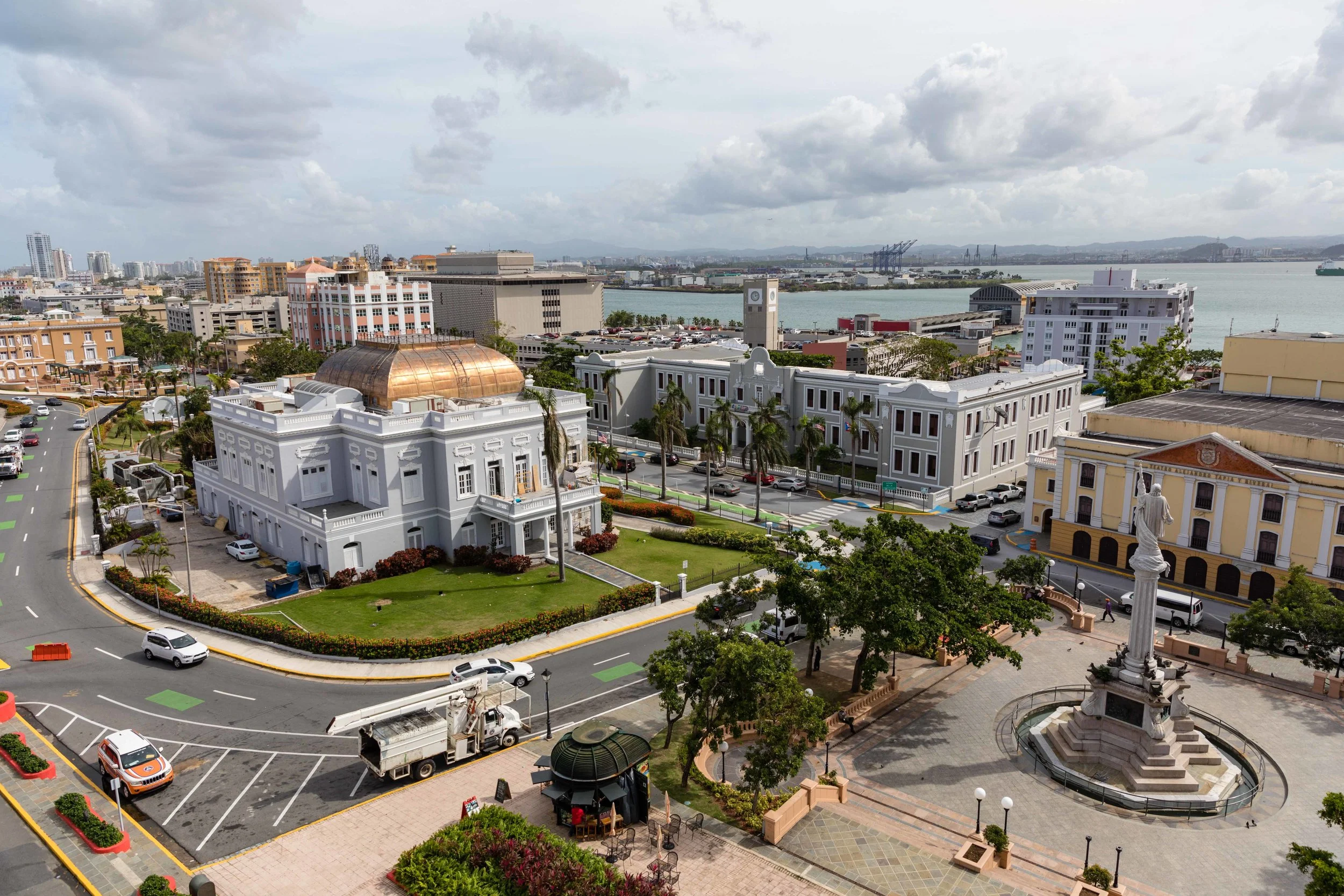
We’re breezing into La Fortaleza, the bright-blue governor’s palace in San Juan’s colonial quarter, as if Levin didn’t just land in Puerto Rico for the first time three months earlier. We head across the lobby’s marble floor and up the stairs to the corner office of PRITS, or the Puerto Rican Innovation and Technology Services. It’s a newly formed unit headed by two former executives -- Luis Arocho, the island’s chief information officer, and Glorimar Ripoll, its chief innovation officer -- and tasked with introducing data science and technology into Puerto Rico’s bloated bureaucracy. It’s also become something of a home base for Levin, a place receptive to his particular brand of entrepreneurship.
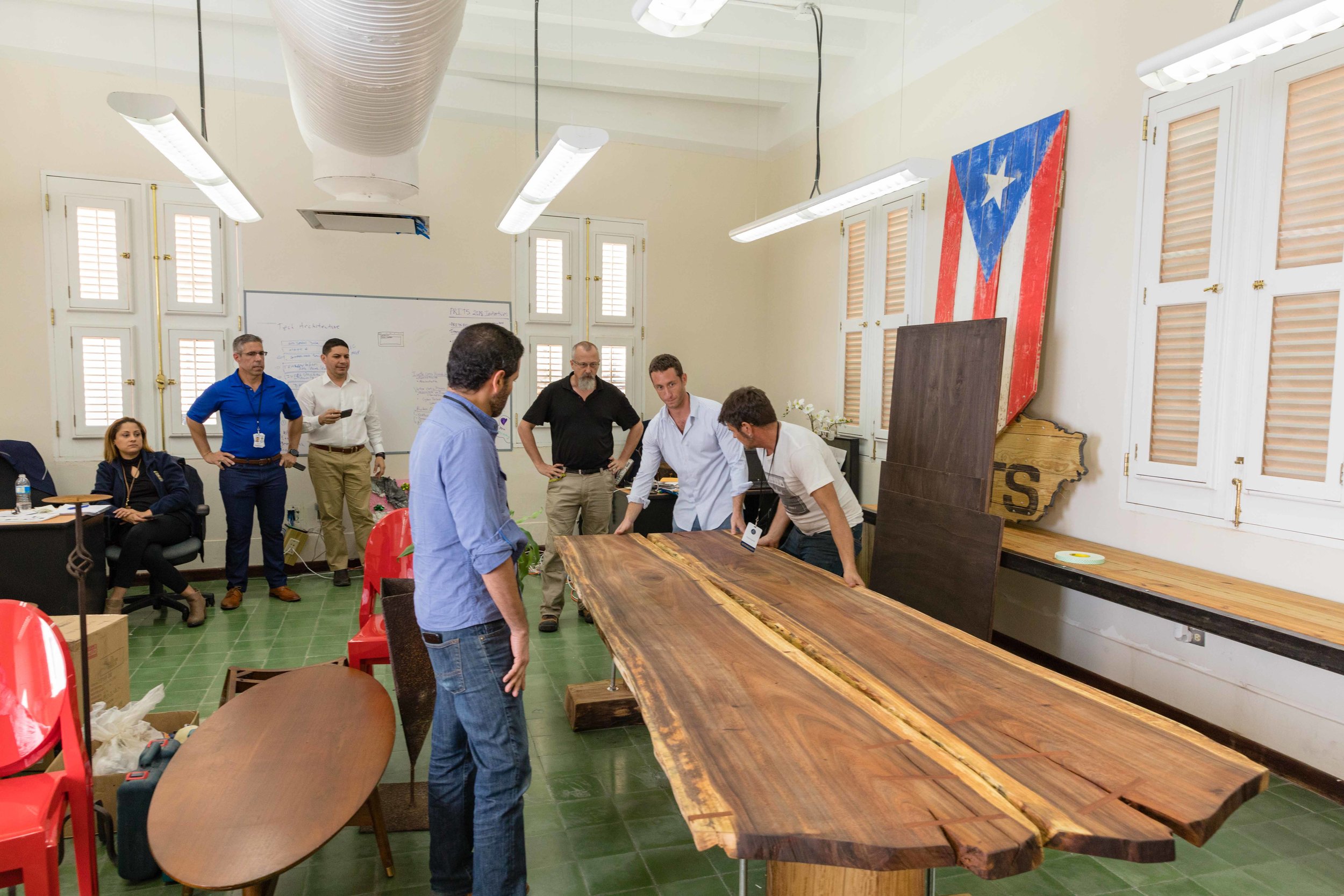
As we approach, we find the office in a flurry of redecoration. A black love seat, armchairs and gold side tables form a new reception area by the door. We stand and watch long slab tables crafted from trees felled by Maria -- and a large wooden PRITS sign emblazoned with the Puerto Rican flag -- being hoisted into an open window by a cherry picker. A giant, flashy canvas donated by a famed local artist, painted with the words La Gran Fiesta, is carried in and then promptly taken away: too much. Levin smiles.
In his vision, everything is scalable -- every relationship, every idea. You start with one thing and build off it. It’s not always easy to draw a straight line from one to the next, but what’s happening in this office, at least, offers a useful pathway of how Levin’s philosophy unfolds.
It started with that project to install satellite terminals. Originally, Levin had asked Arocho, the chief information officer, for help. “I thought, This is great, but knowing government, it probably won’t happen as fast as we need it,” Arocho recalls. It had taken six weeks to request and launch Google’s balloon-powered Project Loon internet service on the island. But when Levin and his team produced the technology in less than a week, Arocho was impressed. “At that moment, I knew these guys were for real,” he says. “They’re forward thinkers. They offer a different approach -- that entrepreneurial mindset -- to dealing with government problems.”
Now Levin had a useful new relationship. Arocho became willing to provide, as he calls it, “top cover” for his efforts -- signing forms when necessary, opening doors. And meanwhile, Levin was repeating this process with other key players around Puerto Rico. He’d befriended the heads of the Foundation for Puerto Rico, as well as key officials from FEMA, the military and the Department of Homeland Security. Leveraging his network, Levin often just connected dots. A cutting-edge, solar-powered water-purification system was installed at a Boys & Girls Club in the town of Loíza because of an introduction Levin made between MIT’s Lincoln Laboratory and the Roddenberry Foundation. He introduced Global DIRT, a disaster response team, to a local organization in St. John requiring assistance, leading to a major response and connectivity operation benefiting the U.S. Virgin Islands. “This connection was immensely valuable,” Devin Welch, a solar-power-business owner, told me.
Direct relationships and one-off operations can only scale so much, Levin knew. What he needed was to re-create what he had with Brooklyn Boulders -- that gathering point where infinite other relationships could thrive and people could find new ways of helping the island. “Whether in business or disaster response, informal relationships are how everything gets done,” he says. So, not long after arriving in Puerto Rico, Levin took over a six-bedroom house near the beach in San Juan that he found on Airbnb. At $275 per night, it came with a bar and an outdoor pool yet cost the same as a room at the nearby Hyatt. Then he invited everyone he’d met for regular Thursday happy hours (but also almost any time), offering a retreat where exhausted relief workers could decompress over cheese, crackers and bottles of Medalla Light, and even crash in a bedroom if necessary. Here, he believed, the silos of NGOs and government and military could break down.
Arocho became a regular. So did senior officials from the U.S. military and FEMA, Puerto Rican bureaucrats and businesspeople and private-sector technology specialists. Smart, young Puerto Rican doers arrived and began working out collaborations with PRITS. A filmmaker hired by AARP showed up and found people to help her document Maria’s impact on the elderly. Members of relief organizations swapped insights, and found partners for their work ahead. “We were better prepared for what was to come during our time there by hearing real stories of what was occurring and needed,” says Tamara Robertson of Engineers Without Borders.
The house created new relationships, but it also continued to strengthen Levin’s existing ones. And that’s how, last January, Levin came to suggest that Arocho redesign the government office. If PRITS is to be an emblem of collaboration and make Puerto Rico attractive to innovators, he argued, the space ought to look the part. Arocho agreed; the office was originally nothing more than a drab, government-issue space. So Levin found a sponsor to put up $15,000, linked in a California-based furniture designer named Marcus Kirkwood and enlisted Levin’s twin sister, Sefra Alexandra, who had also come to Puerto Rico after the hurricane and built seed banks in 26 schools across the island.
Now, on this day in January, we’re watching the fruits of collaboration and relationships. The new tables are being arranged. Sefra is decorating the room with tropical plants. Arocho stands by Levin and looks on happily, snapping pictures.
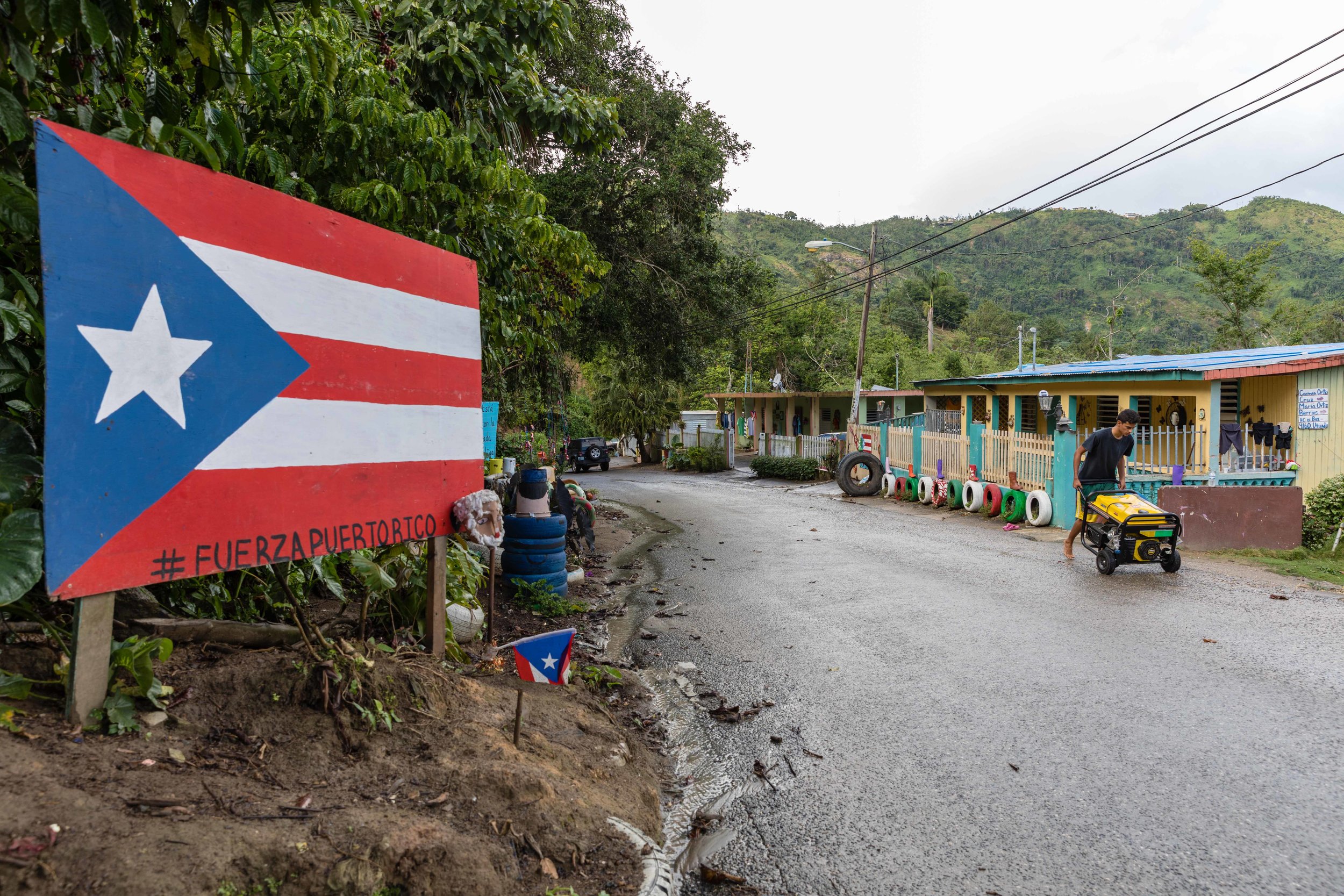
Much of the attention on Puerto Rico’s hurricane response has focused on government’s colossal failures: FEMA’s sluggish response. The island’s struggle to get a handle on the situation. Corrupt utilities and local mayors. Mismanagement and dysfunction. Wastewater systems and an electrical grid left vulnerable after years of neglect.
But there’s another story: how Puerto Rico’s citizens took care of themselves. Neighbors banded together. They shared food, fuel and shelters, driving their own hyperlocal response efforts. Levin talks about Alberto Delacruz, a Coca-Cola distributor he met who mustered 2,000 generators, loaded them on his fleet of trucks and delivered them to stores, clinics, salons and restaurants across the island. “Yes, he wanted his clients back in business,” Levin says. “But he solved a problem.” Necessity also inspired D.I.Y. solutions. I heard about residents powering homespun washing machines with battery-operated drills that they charged with solar panels; about electrifying their homes with car batteries. Local businesspeople began talking of themselves not just as merchants or salespeople but as sources of solutions -- as linchpins of their communities.
This is, it turns out, a regular though less reported part of the disaster-recovery cycle. “History has shown that the disruption of existing traditions, policies and structures can create a climate of innovation and entrepreneurship,” reports a 2017 study in the International Journal of Entrepreneurial Behavior & Research. The research was put together by two DePaul University professors who surveyed decades of reports on how entrepreneurship rises in areas that fall victim to disaster. Their conclusions: Perceptions of entrepreneurship always improve as local people, with their deep knowledge of their community’s needs, become effective in ways that large institutions like government can’t. And local entrepreneurs themselves go through a transformation, shedding anxieties that might have held them back before. “Necessities of the individual and his community override increases in fear of failure,” the DePaul writers report. From this, new solutions are created and new businesses are born.
(This phenomenon extends to Levin himself: The co-directors of the University of Delaware’s Disaster Research Center tell me that, after disasters, independent people often step in to do what he does -- help forge connections. They just don’t typically think of themselves as entrepreneurs.)
However, something is happening in Puerto Rico that the DePaul writers hadn’t chronicled elsewhere. Entrepreneurs from outside Puerto Rico are arriving with vigor. Within days of the storm, scores of technology companies in particular have made landfall, ranging from large entities like NetHope and Tesla, which is launching new battery projects on the island, to smaller makers of passive water collection and purification systems and “mobile ad hoc” wi-fi networks. Many see the island as a test bed for their new technologies. Wealthy cryptocurrency entrepreneurs have arrived en masse, eyeing Puerto Rico’s generous tax incentives, broken systems and humbled government as an exciting set of challenges. “It’s turned out to be this really amazing opportunity to put to work block-chain technology,” Reeve Collins, cofounder of the company BlockV, told me.
Levin watched this happen on the island, and two months after the hurricane, he felt it was time to move on to a new phase of his expeditionary entrepreneurship project -- away from disaster relief, and toward disaster preparedness. (Hurricane season begins in June.) He’d now play superconnector for this new community on the island, locals and newcomers alike, whose products and services could help Puerto Rico in the long run.
By this point, Levin had stopped renting his communal Airbnb; the aid workers who frequented the house had largely left. Now he makes connections on the fly. “I go into an area and try to identify who’s who. And I try to empower them and connect them around a goal,” he says. Over the course of my three days with him in January, this is almost entirely what I witness Levin doing. He meets with property developers and investors and lawyers and local foundations and youth activists and surfers and (of course) cryptocurrency entrepreneurs. We stopped in at a tech accelerator one morning to meet re:3D, a startup experimenting with an industrial 3-D printer to fabricate storm-ravaged stuff like furniture and coral. We had lunch with Milton Soto, an influential bartender who is rehabilitating an elementary school after the hurricane, before stopping by Aqui Se Puede, a watering hole whose owner and resident carpenter once worked for Andy Warhol. For Levin, these encounters are mostly soft touches -- rapport building, part of his overarching effort to piece together a network of “local capacity” in the event of another disaster.
One morning, I join Levin for a 7:45 a.m. workout on the beach with Carlos Guardiola, a well-connected Puerto Rican entrepreneur who owns one of the island’s largest warehousing businesses as well as medical cannabis licenses; Rafael Ortiz, who is in private equity; and Ben Manning, a former Navy SEAL fresh out of eight years in the service, whom Levin had taken on as something of an apprentice. (Each night before bed, Levin and Manning “debriefed” about the day’s meetings and exchanged the lessons learned.)
After burpees and sprints, we sit down for breakfast at a beachfront inn.
Guardiola describes his role as an unofficial connector. “I have a very simple rule: I don’t do business with anybody unless I eat with them seven times,” he tells Levin. “I like to see how you treat the waiter. I like to see who you know around. I like to see how you react. Because everybody’s a great first date.” Since 1996, he’s frequently hosted invite-only salons that bring together venture capitalists, housewives, street artists -- an intentionally diverse mix -- and after the hurricane, that made him a natural contact point for many people on the island. Not unlike Levin, Guardiola began making connections that helped the disaster recovery along. In one case, he connected GivePower, a major clean-energy nonprofit, to local partners to install water desalination and purification systems.
“And that’s how real recovery happens,” Levin says. “It’s understanding the landscape, and making very unconventional, strategic relationships of human capital, and understanding the capacity of respective operating groups, and putting them together.”
“It basically comes down to what we’re doing here -- it’s breaking bread,” Guardiola replies. “I’m not in the business of employing people, because I think that’s what kills Puerto Rico. That whole mindset of I want to get my sure thing. There is no such thing as a sure thing! And that’s why this is really the perfect storm. You know everybody was thinking, Oh, the United States, they got our back. Bullshit! Oh, we’re going to get money from FEMA. Bullshit!”
If Puerto Rico has a savior, they agree, it will be the entrepreneurs on the island -- both the ones born here and the ones flocking in. This is the lesson they took from Hurricane Maria. “Once you realize that no one is here to save you,” Guardiola continues, “that is the most empowering thing, or the most frightening thing. And whoever is frightened should get on a plane and go to Orlando. Get the fuck out of the way.”
One day, before a meeting with a lawyer from a prominent Puerto Rican real estate family, Levin takes me to the ruins of the former Naval Reserve Officers Beach Club. It’s perched over the sea, above a popular surf spot and in the shadow of an old Spanish fort, but it’s an absolute mess: small buildings stripped down to the concrete and covered in graffiti, hunks of wood scattered like discarded toys. The site belongs to the city of San Juan, but he’s actively courting the city government and pitching investors to turn it over to him.
Here, Levin says, is where he can have a truly lasting impact.
“I’m proud of our ability to drop in and be operational, but really, at the end of the day I’m just another guy going out and fixing a radio, or clearing search and rescue,” he says.
That’s why he wants this permanent space -- a place to once more repeat what he learned at Brooklyn Boulders. When he’d bring the climbing gym to a new city, Levin would start by inviting a diverse group of locals -- from investors to artists -- into the space as they were building it. He called the gatherings “hard hat dinners,” and the goal was to get influential constituencies in the community to meet each other and have a say in what became of the space. That way, when it opened, they’d already feel like it was theirs.
This is what’s missing in Puerto Rico right now, he believes. The worst has passed. Electricity is slowly returning. But what about the next Maria? All of this entrepreneurial energy -- the resurgent locals and the innovators coming with their cutting-edge resiliency technologies -- needs a central place to organize around disaster preparedness and recovery. The way Levin envisions it, this could become an open-air market: a hybrid pop-up space where military veterans teach preparedness skills to patrons amid food trucks, live entertainment and off-grid-technology exhibits. He’d been involved in a project like that in Miami -- minus the disaster element, of course -- and thinks it can work here, too.
Recently, Levin signed a one-year lease on an apartment in San Juan. He’s racked up a hefty credit card bill during his time here, but he’s determined to bring his new concept to life and recoup his costs in the process. “Puerto Rico is a phenomenal place to demonstrate this concept of community self-sufficiency,” he says. And if it’s successful, he wants to replicate the idea back in the continental U.S. -- and prepare us all for whatever is to come.

Gateway to Myanmar’s Past, and Its Future
NEW YORK TIMES | As Myanmar opens to the outside world — and an influx of tourists — after decades of totalitarian rule, its monuments attract scholars long put off by the country’s politics.

The ancient city of Bagan, Myanmar. Credit: Andy Isaacson
FIRST PUBLISHED IN THE NEW YORK TIMES, JULY 9, 2012
BAGAN, Myanmar — Fires, floods, treasure seekers and ficus trees have by turns withered this ancient royal capital, but in many ways it still looks as it might have eight centuries ago.
More than 2,200 tiered brick temples and shrines sprawl across an arid 26-square-mile plain on the eastern bank of the Irrawaddy River, remnants of a magnificent Buddhist city that reached its height in the 11th and 12th centuries.
These monuments, on a red-dirt plain thinly populated by monks and goat herders, are an unparalleled concentration of temple architecture, featuring sophisticated vaulting techniques not seen in other Asian civilizations and elaborate mural paintings whose counterparts have not survived well in India.
“It’s as if all the Gothic cathedrals were clustered in one spot,” said Donald Stadtner, author of “Ancient Pagan” and “Sacred Sites of Burma.”
As Myanmar opens to the outside world — and an influx of tourists — after decades of totalitarian rule, Bagan is far from the only site that is now of interest to scholars, many of whom were long put off by the country’s politics.
The Tibeto-Burman peoples from southwestern China who settled the upper Irrawaddy as early as the first century B.C. left behind large cities enclosed by brick walls and moats, and evidence of ingenious irrigation networks.
At Beikthano-Myo, one of the earliest of these settlements, archaeologists have found monasteries and shrines, or stupas, resembling those erected by Buddhists in eastern India, along with ornate burial urns and silver coins bearing auspicious symbols — marking the site as a staging point from which Buddhism spread across Southeast Asia.

Credit: Andy Isaacson
Well before the political opening, Myanmar’s military rulers sought to restore historical monuments and establish local museums. In the late 1970s and ’80s, the authorities undertook a major rebuilding of Bagan, which an earthquake had devastated in 1975.
The restoration, supported by individual Burmese patrons eager to earn religious merit and by the United Nations Development Program, relied mainly on a close circle of domestic experts and has been sharply criticized by some outside scholars.
Critics took issue with the use of inauthentic building materials, like cement in place of stucco, and contend that certain architectural features — in particular the decorative finials that top religious monuments — were reconstructed according to imagination rather than science. A few prominent temples contain incongruous elements like disco lights flashing around the heads of Buddha statues.

Credit: Andy Isaacson
“It’s been an unmitigated disaster,” Dr. Stadtner said of the restoration. “It’s as if every archaeological principle has been turned upside down in the past. I think there would be universal agreement that the damage to the monuments has been done, and is irreversible.”
Michael Aung-Thwin, a professor of Asian studies at the University of Hawaii and a longtime Myanmar scholar, dismisses such criticism as overstated, calling it “propaganda issued by the dissidents.”
“They made tremendous progress given the resources they had,” Dr. Aung-Thwin said.
U Win Sein, who was Myanmar’s culture minister during the 1990s, has defended the government’s renovations, which strived to reconcile antique preservation with Buddhist concepts of donation and refurbishment.

Credit: Andy Isaacson
“These are living religious monuments highly venerated and worshiped by Myanmar people,” he wrote in a state-run newspaper. “It is our national duty to preserve, strengthen and restore all the cultural heritage monuments of Bagan to last and exist forever.”
Elizabeth Howard Moore, an archaeologist and art historian at the University of London, says she expects that Bagan will eventually be designated a World Heritage site, a change that will attract renewed interest from foreign scholars.
Many research questions at Bagan remain, including the nature of Buddhist life in the city and the relationship between the kingdom and its foreign neighbors. (Several of Bagan’s murals appear to have been painted by Bengali artists.)

Credit: Andy Isaacson
Already, the new political climate has invited more foreign technical experts to bring the country up to international standards, and the Ministry of Culture is actively welcoming proposals by outside scholars.
“This was not happening 10 years ago,” Dr. Moore said. “The lifting of sanctions has not only brought renewed cultural awareness at a national level, but increased funding for business has started to encourage more and varied support for cultural and educational programs.”

Credit: Andy Isaacson

Why Men Always Tell You to See Movies
NEW YORK TIMES | Why you never hear women doing voiceovers for movie trailers.

Melissa Disney did the voice-over for the trailer for “Gone in 60 Seconds,” starring Angelina Jolie and Nicolas Cage. Credit: Molly Mahar
FIRST PUBLISHED IN THE NEW YORK TIMES, JANUARY 29, 2012
WHAT gender is the voice of God?
The question has been pondered by mystics through the ages, but in the sanctuary of cinema the voice of a sonorous, authoritative, fear-inspiring yet sometimes relatable presence is, invariably, that of a man. Consider the trailer and the omniscient, disembodied voice that introduces moviegoers to a fictional world.
“Most movie trailers are loud and strong, and film studios want that male impact, vocally and thematically,” said Jeff Danis, an agent who represents voice-over artists. “Even if it’s a romantic comedy or nonaction movie, they still want that certain power and drama that men’s voices tend to convey on a grander scale.”
Even now movie trailers and promos largely hew to a template created 40 years ago by Don LaFontaine, Hollywood’s most prolific voice-over artist. Possessor of a resonant baritone that could cut through tight sequences of music and sound bites — and the coiner of familiar (and parodied) phrases like “In a world ...” and “One man, one destiny” — LaFontaine, who died in 2008, voiced more than 5,000 trailers, thousand upon thousand of commercials and television promos.
Photo
Melissa Disney did the voice-over for the trailer for “Gone in 60 Seconds,” starring Angelina Jolie and Nicolas Cage. CreditTouchstone Pictures
In the past few years, as audiences have grown more sophisticated, the independent production companies that make trailers for Hollywood studios have begun moving away from voice-overs, favoring graphic devices like title cards to serve as narration. “As much as possible people are trying to let the movie speak for itself, without being as heavy handed as the ‘voice of God’ narrator feels,” said John Long of Buddha Jones Trailers, which was responsible for campaigns for “Kung Fu Panda 2” and “Inglourious Basterds,” among others.
Still, plenty of voice-over jobs remain, especially in television, though women are seldom cast. “There are some very talented, very gifted women in this business that can satisfy any request for a narrator, but the opportunities aren’t given to them,” said Mike Soliday, a talent agent who represents prominent male voice artists like Scott Rummell and Tony Rodgers.
As Mr. Danis put it, “Trailers are really the last frontier for women.”
Mr. Long noted that his company had worked on dozens of campaigns a year, “and as much as everyone talks about wanting to be innovative and do unexpected things, the idea of a female voice doesn’t come up that often,” he said. “It’s really not part of the formula. Maybe that’s our own shortsightedness.”
Asked to name a theatrical campaign that featured a female voice, trailer makers interviewed for this article could easily recall just one: “Gone in 60 Seconds,” the 2000 action thriller that starred Nicolas Cage and Angelina Jolie. “It was filled with really sexy and fast and fantastic-looking cars, and shot with a ton of energy,” recalled Skip Chaisson of Skip Films, who produced the trailer. “What else did it need? I thought it would be cool if we had a really sexy female voice. In a way we were doing a car commercial, so why not go as far with it as we can?”
Advertisement
Continue reading the main story
Advertisement
Continue reading the main story
Advertisement
Continue reading the main story
Melissa Disney, who did the voice-over for “Gone in 60 Seconds” and works frequently on television promos, commercials and animated series, argued that “men are very attracted to women’s voices, especially when they are sexy and sultry.” She continued: “Women have such a large range. We have so much more to pull from than your typical male action voice.”
One challenge women face is the perception in the industry that it’s difficult for their voices to be heard over a trailer’s cacophony, an attitude some voice-over artists dispute. “To say that a woman’s voice won’t cut through a trailer just isn’t true,” said Joan Baker, the author of “Secrets of Voice-Over Success” and a friend of LaFontaine’s. “What women’s voices have is emotionality and color and a certain kind of rhythm. Don would even say, ‘My voice isn’t right for everything.’ He felt it was ridiculous that women were not used in movie trailers. But no one wants to change what isn’t broken.”
Do moviegoers want to hear female voices? Research indicates that our brains are wired to prefer theirs to male ones; that’s the reason robotic voices, like those in GPS devices, tend to be female. (This probably has an evolutionary explanation: fetuses in the womb, identifying with their caretaker, can distinguish their mother’s voice from others, a study published in the journal Psychological Science found.) When it comes to credibility, however, research into the perceived believability of a voice — an important quality for the omniscient narrator of a trailer, as well as the spokesman or -woman for any product, which is the function a trailer serves — tells a different story.
“On average both males and females trust male voices more,” said Clifford Nass, a professor of communications at Stanford, noting some gender disparity exists in that women don’t distrust female voices as much as men distrust them. In one study conducted at Stanford two versions of the same video of a woman were presented to subjects: one had the low frequencies of the woman’s voice increased and the high frequencies reduced, the other vice versa. Consistently subjects perceived the deep voice to be smarter, more authoritative and more trustworthy.
Science aside, the conventional wisdom in the movie industry has it that audiences respond more favorably to trailers with male voice-overs. “People don’t buy that product from women, and I don’t know why,” said Seth Gaven of AV Squad, which produced the trailers and television campaigns for “The King’s Speech” and “Captain America.” “Female voice-overs don’t have the same credibility. Sometimes I’ll even consider a few guys with similar voices, and one might be a little more resonant and commanding, even in a subtle way. He usually gets the job.”
In television many cable channels regularly aim programming at women, and there has been more latitude in the use of female voices. “We’re all trying to make shows that cut through the clutter and stick out,” said Tim Nolan, senior vice president for marketing at Lifetime Networks. “But for me it’s less about being authoritative and more about being relatable. It’s a big turnoff for TV consumers if they think they’re being sold. Whether the show’s about fashion or drama or reality, it’s about which voice is telling those stories better.”
In testing “One Born Every Minute,” a Lifetime series set in an Ohio maternity ward, the channel found that audiences responded most favorably to a voice-over by Jamie Lee Curtis, even before they recognized her, Mr. Nolan recalled, adding: “One women said that the voice understood who she was.”

A Beautiful Mind
POPULAR SCIENCE | Can Ariel Garten's brain wave interface improve your outlook on life?

Ariel Garten. Credit: Chris Thomaidis
FIRST PUBLISHED IN POPULAR SCIENCE, JULY 2014
IN COLLEGE, ARIEL GARTEN started a clothing line that took its inspiration from neuroscience. She hooked people up to an electroencephalograph (EEG) to record their brain waves, then emblazoned T-shirts with the spiky patterns reflecting their mental activity. She also sewed skirts with 37 pockets, a reference to the number of different brain faculties described in the Victorian pseudoscience of phrenology, and filled them with bric-a-brac to represent the subconscious. At age 34, Garten is still making geek-chic designs—only now her creations can actually read people’s minds.
Garten is shoeless as she leads me through the Toronto headquarters of InteraXon, the start-up she co-founded in 2007. Her long brown hair nearly brushes her elbows as she pads along the wood flooring in brightly patterned socks. A whiteboard scribbled with nerdy wordplay and equations spans the length of one wall; neon Post-its are applied liberally elsewhere. Garten pushes open the door to a conference room called the Cerebroom and takes a seat at the table.
“I was always exploring relationships between art and science,” she says. During her stint as a fashion designer, Garten was double-majoring in psychology and biology at the University of Toronto, where she also began working with professor Steve Mann. A pioneer of wearable computers, Mann created digital eyewear to augment vision in the early 1980s. (“He basically developed Glass before Google,” Garten says.) Mann had also engineered a primitive brain-computer interface at MIT in the 1990s. Garten and some classmates decided to resurrect it to explore thought-controlled computing.
As a pilot project, the team produced a series of concerts at which audience members wore a version of the device. By manipulating their brain states, the spectators could influence the pitch and volume of synthesized instruments on stage. “We kept getting deeper and deeper into brain-wave technologies and what we could do with them,” Garten says. As they grew more ambitious—at points inventing a thought-controlled beer tap and levitating chair—the team formed InteraXon. For the 2010 Winter Olympics in Vancouver, they created an installation in which visitors could use a headset to control light displays on landmarks across the country, including Toronto’s CN Tower, Ottawa’s parliament buildings, and Niagara Falls, in real time.
“After the Olympics, we began looking at more complex applications,” Garten says. “And we realized we had a system that allowed you to form a relationship with technology.” InteraXon then set to work developing, in essence, a Fitbit for the brain—a wearable biofeedback device that measures neural activity, much like an activity tracker records steps and calories burned. “I think we’re all very curious about our own minds,” says Garten, “but we just may not have the tools to channel that.”
Garten passes me a sleek white headband called the Muse, the company’s first commercial product. The human brain contains billions of neurons that communicate via electrical impulses, and aggregate into waves of different amplitudes: Alpha, for instance, dominate when we’re relaxed or focused; beta kick in we problem-solve. The Muse transforms this brain activity into information that can be tracked wirelessly on a tablet or smartphone.
Muse is intended for daily use with an app called Calm, which features a three-minute exercise designed to help people manage stress. Through headphones, users can hear their brain waves represented as the sound of wind. Calm states beget gentle winds; distracted or agitated states elicit a roiling tempest.
Psychologists at Harvard University have shown that people spend 47 percent of their waking hours thinking about something other than whatever it is they’re trying to focus on. Neuroscientists call this tendency toward mental drift the “default mode network.” With neurofeedback, Garten believes people can build their cognitive strength. “If you’re having a crappy day, it can help you gain control of your mind,” she says. “Like, ‘I’m not calm now, but I know what to do to get there.’ ”
The Calm app follows in the tradition of the Buddhist principle of awareness, and the instructions it issues are similar to the Japanese Zen breath-counting meditation known as susokukan. Mindfulness, as such practices are popularly known, has been a growing focus of Western empirical research. The National Institutes of Health, for example, has funded dozens of studies that test mindfulness techniques.
Because InteraXon emphasized comfort when designing Muse, the device could be a valuable tool for scientists conducting such research. Norm Farb, a doctoral candidate in experimental psychology at the University of Toronto, is developing a six-week pilot study to measure the extent to which Muse can help control stress. “A lot of my research has looked at meditation and yoga, and there’s evidence that these can work for people with a mood problem,” Farb says. “So can Muse be training wheels for that?” With McMaster University in Ontario, InteraXon is examining how Muse can improve cognitive function, and an education lab at New York University is measuring the effect of Muse on learning.
There’s an obvious irony to the notion of computer-aided meditation. Many seek practices like mindfulness as an antidote to the distractions of today’s technology. We unplug to find calm. Garten appreciates this but says that sometimes people need a more accessible tool to achieve focus. “There are potential places that technology can take us that we can’t reach on our own,” she says.
Using InteraXon’s software, anyone can design compatible apps. Garten envisions a broad array of possibilities, including apps that treat children with attention-deficit hyperactivity disorder and help athletes prepare for games. Eventually companies might get alerts when the brain waves of workers in high-stress jobs, such as air-traffic control, signal fatigue.
We leave the Cerebroom and walk past engineers conferring around workspaces cluttered with cables and prototypes. In the center of InteraXon’s office, a sitting area contains two egg-shaped chairs with speakers at ear level. Garten settles into one and gestures for me to take the other. “Imagine coming home and Muse senses you’ve had a stressful day,” she says, “and so the lighting adjusts and your home stereo starts playing your favorite relaxing music.” Garten sinks back into the chair with a slight, serene smile and closes her eyes.
Bliss and Sociability Where the Earth Draws a Bath
NEW YORK TIMES | Hot springs provide spiritual renewal and priceless views.

Credit: Andy Isaacson
FIRST PUBLISHED IN THE NEW YORK TIMES, MARCH 19, 2009
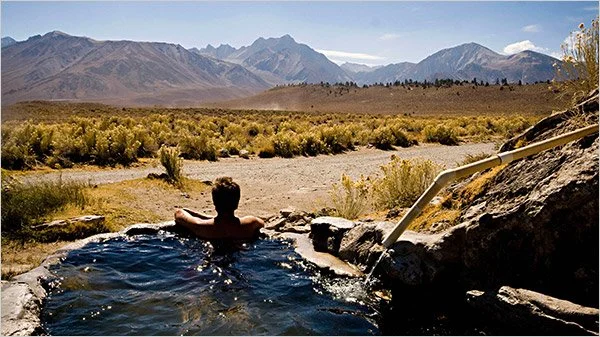
I WAS conceived into water. This doesn’t occur to me as a conscious thought so much as a body memory while I lie incubating, and shriveling, in a hole of thermal spring water on a high desert plain in eastern California.
But the experience sure seems womblike. Before me, the Sierra Nevada’s jagged crest looms naked and raw, as I no doubt appear in the tub. A breeze blows across yellow-tipped rabbitbrush, cooling my exposed shoulders. There are no other human beings around — none to warn about the dangers of overexposure, none to take my money — so into the soothing water I freely sink, my limbs spread open to a cloudless sky.
Not all hot springs evoke embryonic bliss. Others can be social affairs, resembling a Vegas hotel pool with more sulfur and body hair. Near my home in the San Francisco Bay Area, on occasion, the Pacific tide is low enough to expose a thermal spring trickling into a rocky tub on shore. Experiencing this ephemeral event requires descending a steep, unmarked path from Highway 1, usually at dawn.
The gaggle of bathers that converges there reminds me of those red-faced macaques I’ve seen pictured soaking in snowbound thermal pools in the Japanese Alps — only grooming, as Northern California’s higher primates do, with foot and shoulder massages. If this were New York, the tub might comfortably accommodate 6 strangers, but here, it packs at least 16. Comfort is culturally relative.
I love hot springs like these — undeveloped, natural and free. Nature’s spaamenities are largely immaterial: solitude and human connections, spiritual renewal and priceless views — even adventure. Cheap luxury is undeniably a draw, and when I first dip into a therapeutic spring I usually get giddy, like someone who has found himself and his backpack richly upgraded from a single room into a suite. But the sybaritic appeal goes deeper. The occasionally cramped tubs, the inconvenience of getting to them — these are appropriate compromises for what a pool of thermal water lying bare on the earth’s surface affords: immersion into something ancient and primordial.
The American West is pockmarked with hot springs. Heated by deep magma chambers, much of the water emerges scalding or inaccessible on private property. But in rare instances it arrives at a delightful temperature on scenic public lands where it is available to all comers as a quasi tax return.
My initiation was as a new college graduate on a westward migration. The hot spring, in Oregon, was as much an introduction to West Coast culture as a means to soothe driving-muscle aches. Nude public bathing was foreign to me at the time, but I soon understood that wearing a bathing suit in this kind of spring was like using a fork in an Ethiopian restaurant: culturally awkward, somewhat antisocial and generally antithetical to the underlying idea. The forced intimacy between undressed strangers actually encourages friendly and inspired chatter, as it might between travelers meeting at a remote oasis.
Since I settled in California, books like “Hot Springs and Hot Pools of the Southwest” by Marjorie Gersh-Young and printouts from soak.net have become my faithful road trip companions. (The location of some undeveloped tubs is closely guarded by locals, revealed only after cultural profiling; wearing a fanny pack would probably not help.)
While driving across the desolate Highway 50 through central Nevada, on a trip from San Francisco to Colorado, I was directed down a washboard side road seemingly toward the middle of nowhere. Wild burros grazed in sagebrush. After a cattle guard and a turn, three steaming tubs were suddenly revealed, perched on the edge of the wide, deserted valley with a stunning panorama of the Toiyabe Range. I recall thinking, as a bargain hunter might: Why would anyone ever pay full retail for this? Someone — hot springing has an industrious volunteer subculture — had laid smooth stone seats inside the tubs and wood platforms on the rim. As I settled into the sublimity, my nose picked up a faint whiff of a deer carcass. Or maybe it was a burro. Either way, aromatherapy it was not, but I was hooked.
Every hot spring has its own authenticity, and over time I have developed an appreciation for their diversity of scenes and settings. A spring on the east bank of the Rio Grande, outside Taos, N.M., invites dips in the warm tubs after lazy floats downriver, a cycle I once repeated for hours, until my raisin hands looked like something I should be concerned about.
Just reaching an isolated spring deep in the mountains of Big Sur requires a 10-mile hike through coastal redwoods and chaparral. I visited with my girlfriend; romantic touches — candles left by previous soakers on the mossy ledges of the rock-lined tubs, the babble of an adjacent river — inspired a communion with the surrounding forest.
When possible, I figure hot springs into my travels abroad. Much like, say, birding, visiting hot springs is a conceit for seeing a country off the beaten track, and their universality allows me to transcend the foreignness of a place. Thermal water is comfortable and familiar, even while the geography or culture is not.
The Blue Lagoon in Iceland may be that geothermal hot spot’s most iconic pool of therapeutic water, but my most memorable Icelandic soak was under the dusky midnight sky on rural land owned by a provincial church, which doesn’t make branded anti-aging creams. The only inhabitant around, a half-mile from the unmarked spring, was the pastor himself, who actually lived with a flock of sheep. After my soak, I visited him, and as we spoke he politely excused himself to assist a ewe in labor, which he did successfully, wearing a tweed sport coat.
Paradoxically, it was at a hot spring in one of the most remote and inhospitable parts of the planet where I was made to feel most deeply at home. The Salar de Chalviri, in southwest Bolivia, is a forbidding volcanic region at about 14,000 feet in elevation, where spring water of pleasurable temperature collects in small pools on the rocky, mineral-stained soil. There is a God’s Country quality to the place. When I passed through there one morning on a Jeep tour, the tubs afforded a sanctuary, a geothermal mikva, amid the denuded landscape. The sun’s slanted light mixed with steam rising off the water to produce an ethereal glow, leaving me to bathe soulfully in the gift of creation.

Gold Medal Gamble
SKI | In size and terrain variety, the Olympic venues in Krasnaya Polyana are comparable to France’s Les Trois Vallées. But will they survive after the torch is extinguished?

In size and terrain variety, the Olympic venues in Krasnaya Polyana are comparable to France’s Les Trois Vallées. But will they survive after the torch is extinguished?
FIRST PUBLISHED IN SKI, FEBRUARY 2014
PAUL MATHEWS ARRIVED IN THE CAUCASUS on the private jet of a Russian plutocrat and for a week was chauffeured around the mountains in an armored Mercedes with an escort of several dozen police cars and a bodyguard named Sacha who looked like a stand-in for Arnold Schwarzenegger. There were state dinners and vodka toasts and a pig roast in the forest. “It was like an acid trip,” says Mathews, a veteran mountain-resort designer, recalling the exploratory trip he took in 2000 to scout ski areas in southern Russia.
Mathews, the president of Ecosign—a Canadian company that has designed over 380 mountain resorts in 36 countries, including Whistler Blackcomb, Canyons Resort in Park City, Zermatt, and Courchevel—had been invited by the Russian government to evaluate the potential for an international mountain resort complex in the north Caucasus. Wealthy Russians were spending an estimated $2 billion each year at resorts in the Balkans and the European Alps; surely they could be enticed to spend some of it in their own country.
The Caucasus range, which spans Russia and Georgia between the Black and Caspian Seas, lies on approximately the same latitude as the Colorado Rockies. The tallest peak, Mount Elbrus, at 18,510 feet, is higher than any in Europe. Mathews spied the most promising terrain in the Mzymta River Valley above Sochi, a popular, mild-weathered resort city on the Black Sea coast where Russians had been escaping their brutal winters since Czarist times. A 40-minute drive into the mountains, the sleepy town of Krasnaya Polyana was tucked along the river beneath steep, craggy peaks that loom 5,800 vertical feet overhead, with faces that bear large, glaciated bowls and massive avalanche paths. To Mathews, the place resembled France’s sprawling Les Trois Vallées, with huge potential for skiing. There seemed an almost perfect ratio of beginner, intermediate, and expert terrain and the capacity for 90,000 skiers a day. One family-owned ski area had been operating in the valley—Alpika Service, which had a few rickety doubles—as well as two heli-skiing outfits, one French and one Russian.
Mathews recommended a plan for seven ski areas that could be linked, along with three village centers, golf courses, and nordic facilities. The project moved forward, beginning with Gazprom Mountain Resort, bankrolled by the world’s largest natural-gas company, which is majority-owned by the Russian state. Farthest upriver would be Rosa Khutor, the crown jewel of the valley, which Vladimir Potanin, one of Russia’s richest men, stepped forward to develop.
Roger McCarthy, former co-president of Vail Resorts’ Mountain Division, was brought in during the winter of 2007 to help launch Rosa Khutor. McCarthy had done rebuilds of a few ski resorts, including the turnaround of Quebec’s Mont Tremblant. The prospect of getting in on the ground floor attracted him. “I had three major questions,” McCarthy says. “Are the mountains real? Is there enough snow? And do they have enough money to get this thing done this right?”
Right away, driving into Krasnaya Polyana, McCarthy satisfied his first two concerns. He was flown in on an Mi-8 military transport helicopter (“the thing was like a flying school bus”) to the future upper base plateau of Rosa Khutor, where he recalls stepping out into snow that reached his armpits. The lake effect off the Black Sea can send Krasnaya Polyana huge winter dumps (or rain at lower elevations). Snow would not be an issue.
And with Vladimir Potanin, an avid skier with a net worth of $14.3 billion, neither would money. McCarthy recalls his first meeting with the magnate, who controls Interros, a conglomerate with large stakes in mining, at a fortified office building in Moscow. Once he cleared the heavily guarded parking lot, McCarthy had to pass through an airport-style X-ray scanner at the entrance, followed by a revolving Plexiglas tube in the lobby, where an “NFL lineman,” who spoke into a device on his wrist, led McCarthy up an elevator and two flights of stairs to a meeting room. “As a guy in the ski industry,” McCarthy recalls, “this was certainly nothing I’d experienced before.”
In 2005, when Moscow lost its bid for the 2012 Summer Olympics to London, Russia’s Minister of Sport asked Mathews to explore whether Krasnaya Polyana could possibly host a Winter Games. Ecosign had designed the master plans for Nakiska, the site of the 1988 Calgary Winter Olympics, and Snowbasin, for the 2002 Salt Lake downhill and super-G events. Mathews hired Bernhard Russi, the Swiss ski-racing legend and a leading authority on downhill course design, to scope out Rosa Khutor.
To McCarthy, an Olympic bid for a resort that had never hosted a race—or run a ski lift—seemed like “a fairly aggressive dream” at the time. “They were bidding for the Olympics, and they didn’t have anyone who really knew anything about the ski business,” he says. But the terrain checked out, and this was Russia: Money reigned, rules could be bent, and the president loved to ski. Mathews, alongside President Putin, pitched Sochi to the International Olympic Committee.
This was the moment when plans for Krasnaya Polyana morphed from “grandiose,” as Mathews describes his original designs, into something “super turbo grandiose”—a showcase or, depending on your point of view, a boondoggle. Since the IOC awarded the Games to Sochi, the Mzymta River Valley has seen the largest concentration of ski-industry investment in the world. An $8 billion high-speed rail line, bored into the mountainside and elevated above the river in some parts on massive stanchions, is capable of whisking 800 people from Sochi to Rosa Khutor in under half an hour. Rosa Khutor possesses the world’s most robust snowmaking system, which is said to have cost $100 million. (Ecosign’s original plans for Rosa Khutor—including lifts, trails, and snowmaking, but not buildings—called for $165 million, which, Mathews says, “was already a stupid number.” Recent news reports suggest that figure is now closer to $650 million. And with buildings, the number creeps to $2.2 billion.)
Enter the valley today on a new two-lane highway, and you pass a string of colossal hotels and condominiums designed to keep the Olympics running smoothly for a fortnight. What happens after that, though, is anybody’s guess. “What’s being built now is for a 16-day wonder, but I’m not aware of any economics that were done for the after-Olympics usage,” says Mathews.
Gazprom Mountain Resort, across the valley, bought Alpika Service for a reported $80 million and upgraded and expanded the former mom-and-pop area. Gazprom is a mostly beginner mountain with an outsize base area boasting high-end retail stores. (Gazprom will host the nordic events for this winter’s Games.) Russia’s state-run lender OAO Sberbank, whose annual revenues exceed those of Bulgaria, has a controlling interest in Gornaya Karusel (“Mountain Carousel”), the fourth ski area in the valley, which is essentially a string of gondolas rising from a gargantuan hotel and apartment complex. It has some terrific high-alpine advanced terrain, but it is so limited that, in Mathews’s estimation, it might not be a particularly viable ski area.
That’s not the case with Rosa Khutor, which has a charming, if antiseptic, base area designed to vaguely resemble an Alpine village. Facades of seven-story international hotels, all of matching architecture and with chic ground-floor restaurants, line both sides of the river, which has a pleasant esplanade and lamplit pedestrian bridges. The focal point of the base area is a clock tower fronted by a brick plaza. There’s an indoor skating rink a short walk away, a rental shop, and retail stores. Two gondolas leave the lower base in the valley, at 1,800 feet, for the upper base area, at 3,800 feet; one connects Rosa Khutor to Alpika Service. Much of the resort’s current 500 skiable acres (plans call for more to be added) is off-piste, above treeline, and avalanche-prone, with spectacular views of the North Caucasus. A full-service Spanish restaurant sits atop the summit, at 7,600 feet.
One has to wonder how the resorts in the Krasnaya Polyana valley will be able to fill all those beds after 2014. “It’s an extraordinary experiment, with billions of dollars, to see if Russians will ski in their own country,” says McCarthy. (His involvement in Rosa Khutor ended after eight months.) “If [Rosa Khutor] was in North America, it would be a kickass resort—there’s no two ways about it. But you’re dealing with absolute neophytes. If you buy a Ferrari, you need to know how to drive and maintain it. I’ve worked on a few [resort] bankruptcies since 2008, and I’ve come up with a theory, the Rule of Three: It needs to be within three hours of a million people. It just costs so much, and you need that driving market. You can be a destination resort, but it’s really tough to get people in by planes.”
Sochi, however, may prove the exception. It’s already a popular summer destination, and it’s only two hours by plane away from Moscow, which has a population of 12 million and one of the world’s greatest numbers of billionaires, who typically ski abroad. Paul Mathews believes Krasnaya Polyana is capable of drawing two million annual visitors. “It’s going to be a real resort center for Russia. There’s no question.” (Ecosign worked on Rosa Khutor through 2011.)
The task of creating the draw falls in part to the French outfit Compagnie des Alpes. CDA, which manages some of the most famous resorts in Europe, including until recently Verbier and Courmayeur, has a 25-year agreement with Potanin to manage Rosa Khutor (the ski operations, not hotels or concessions). I met the resort’s general manager, Jean-Marc Farini, at the swanky bar off the lobby of the Park Inn by Radisson.
Farini concedes that his company is entering uncertain territory. “We are creating a new offering in Russia that has not existed before,” he says. “Nowhere in Russia can you find international hotels and good restaurants close to a chairlift. We have 90 kilometers of slopes that provide excellent snow from November to the beginning of May. Our resort is saturated during the Russian holidays, and with 1,500 meters of vertical, we definitely match the best European resorts. Those are the facts. What will be the answer of the market? We can never be 100 percent sure. But 50 years ago, many people didn’t believe there could be any visitors to La Plagne,” which CDA owns and which is one of France’s most popular ski areas. “It now receives three million skiers a year. Russia is a brisk market, one of the few in the world with increasing numbers of skiers and snowboarders. We believe Rosa Khutor will create a new [domestic] market.”
What Rosa Khutor will not be is a straight import of a French ski resort. “We cannot just make a copy. We have to adapt to the Russian culture and Russian expectations,” Farini says. But many of Compagnie des Alpes’ efforts so far, beyond making Rosa Khutor ready for the Olympics, have been to introduce Western standards of safety and guest experience—in other words, to make the place less Russian. “We want to change something in the feeling of the guests who are coming to Rosa Khutor,” Farini says. “Our goal is to have friendly people at guest services. But in Russia that hasn’t been done before. You still have this Soviet legacy [where] people don’t care.”
“Have you been on the road in Russia and seen how people are driving?” adds his colleague, Jean-Louis Tuaillon, who oversees the resort’s day-to-day operations. “They are skiing the same way. The typical Russian experience is wild skiing.”
“Basically [Russians] do not follow the rules,” Farini goes on. “They don’t heed the boundary or the warning signs you put on the slopes. For the cash registers, I wanted to adopt a single line, so you go up to the first one that’s available. But that just doesn’t work in Russia! So it forces us to adapt our own way of organizing a ski resort. This will never look like an American or European ski resort—but it will be safe.” Farini pauses thoughtfully. “We’re building in five years what took 50 years in France.”
How the Dark Knight Became Dark Again
THE ATLANTIC | Batman started serious, went campy in the '60s, and was steered by a superfan back to the grimness of Tim Burton's 1989 movie and of Christopher Nolan's present-day trilogy.

FIRST PUBLISHED IN THE ATLANTIC, JULY 17, 2012
The Batman who shows up in Friday's The Dark Knight Rises actually is something like your grandfather's Batman. Uttering a barely intelligible growl, facing off against villains that recall real-life terrorists, and confronted again and again by his own mortality, the Bruce Wayne imagined by director Christopher Nolan reflects the grim avenger that debuted in 1939, so po-faced that in 2008's The Dark Knight the Joker took to taunting him about it: "Why... so...serious?"
Batman has been so successfully remade in recent years that we scarcely remember how, for a generation, the Dark Knight lived in the public imagination as a pot-bellied caped crusader with a goofy sidekick. ABC's live-action BatmanTV series, which ran from 1966 to 1968, was deliberately campy ("To the Batpole!") and created a long-enduring association between the superhero and the cartoonish onomopeias "Pow!" "Zap!" and "Wham!"
The story of how the farcical Batman of the '60s transformed into the solemn one of today mirrors the elevation of the comic book in general from belittled kiddie fare to the subject of academic inquiry and box-office-breaking, R-rated action movies. It's also a story of a 73-year-old franchise returning to its roots, reflecting its times, and helping build a multibillion dollar industry that churns out branded merchandise, video games, theme park attractions and annual conventions. And it's the story of one fan named Michael Uslan, who, as an 8th grader in the '60s, made a vow to save Batman.
USLAN GREW UP IN NEW JERSEY, the son of a stonemason and a bookkeeper, and escaped into comic books. He first discovered the Harvey Comics—Richie Rich, Casper, and Little Archie, by Archie Comics Group—and later Superman, which turned into an obsession. (He would write letters to the editors notifying them of "boo-boos" he spotted on the pages.) At age eight, Uslan graduated to the scarier Batman comics, where like many children, he found a hero to emulate. "I truly believed that if I studied real hard, and worked out real hard, and if my dad bought me a cool car, I could become this guy," Uslan, now 60, says. "That was when I said, 'I want to write Batman comics.'"
The ABC Batman series Uslan saw on TV didn't reflect the comic-book superhero he so loved. Producer William Dozier reportedly instructed Adam West, who played Batman, to deliver the caped crusader's silly lines "as though we were dropping a bomb on Hiroshima, with that kind of deadly seriousness." All of this pained Uslan, then a nerdy teenager. "The whole world was laughing at Batman and that just killed me," he says. "One night I vowed to erase from the collective consciousness those three little words: Pow! Zap! and Wham! I said, 'Somehow, someday, someway, I am going to show the world what the true Batman is like.'"
The true Batman, to Uslan, was the character originally co-created in 1939 by DC Comics' Bob Kane and Bill Finger, who imagined Batman as a shadowy creature that stalked criminals under darkness. Kane and Finger drew their inspiration from divine heroes throughout the ages, as Superman's creators has done before them, only they made Batman out to be more like Zorro and the Shadow, the dark mystery men of silent movies and pulp fiction. While the makers of Superman "played with the bright and impossible, Bob and Bill expanded that meme by adding the coin's other side, the dark and improbably possible," writes Travis Langley, a professor of psychology at Henderson State University. "Duality and obsession, his enemies' and his own, fill his stories." (Later, after Robin was written, Batman was softened to fall in line with Superman and the publisher's other more agreeable heroes.)
As an undergraduate, Uslan attended Indiana University, which at the time had an experimental curriculum department in the College of Arts & Sciences that allowed any student to pitch an idea for a non-traditional course that had never been taught before, and if the faculty approved, teach it. Naturally, Uslan created a course on comic books as modern day mythology ("the gods of Egypt, Greece and Rome still exist, although today they wear spandex and capes"), and presented his case before a committee in an Amazing Spider-Man t-shirt—"for impact," he later said. One dean, Uslan says, scoffed at the idea of comics as contemporary folklore. Uslan asked if he was familiar with the story of Moses. The dean said he was, so Uslan asked to indulge him by recounting the tale. Then, Uslan asked him to recall the origin of Superman, which begins with a scientist and his wife placing their infant son in a little rocket ship. "Suddenly, the dean stopped talking. He stared at me for what I was sure was an eternity," Uslan writes in his memoir, The Boy Who Loved Batman. "And then he said, 'Mr. Uslan, your course is accredited.'"
Uslan says he took the news to United Press International, the wire service based in Indianapolis. Pretending to be an offended citizen, he asked to speak with the education beat reporter. "I hear there's a course on comic books being taught at Indiana University," he said. "This is outrageous! Are you telling me as a taxpayer that my money is going to teach our kids comic books?! It must be some Communist plot to subvert the youth of America!"
Uslan was playing to a prevailing cultural sentiment that held comic books responsible for a range of social ills. Fredric Wertham, a German-born American psychiatrist who made his name as a consulting psychiatrist for the New York court system and was a champion for civil rights (he provided information that helped the Supreme Court end school desegregation), was its most vocal exponent. In his 1954 book Seduction of the Innocent, Dr. Wertham argued that crime comics were behind a rise in juvenile delinquency—a view foreshadowing modern-day arguments about violent video games—and that comic books in general stilted kids reading, created young Communists, and caused asthma, since children were playing outside less. Boys who read The Adventures of Batman and Robin could become gay, and girls who read Wonder Woman could become lesbian. Testifying before the United States Senate Subcommittee on Juvenile Delinquency, which took up his concerns, Wertham is said to have declared that "Hitler was a beginner compared to the comic-book industry."
The backlash that Wertham inflamed ultimately stoked comic-book burnings in some American communities, and led to the creation of the Comics Code Authority, a code of self-censorship that forbid suggestive postures, banned sympathetic criminals and the portrayal of drug use, and also demanded realistic drawings of women, exaggerated bosoms be damned. The code lasted up until just last year.
Uslan's feigned indignation paid off. UPI ran with the story of the world's first accredited university course on comic books, and the long-haired Uslan was soon taking interview requests from major television networks, newspapers, and magazines like Family Weekly and Playboy. Three weeks later, his phone rang: It was Stan Lee from Marvel Comics, the venerated co-creator of Spider-Man, X-Men, Fantastic Four, The Hulk, and the entire pantheon of Marvel superheroes. "This course you're teaching is great for the entire comic book industry," he told Uslan. "How can I be helpful?" Then, just two hours later, Uslan recalls, the vice president of DC Comics in New York—the publishers of Superman, Batman, and Wonder Woman—also phoned. He wanted to offer Uslan a summer job.
One morning that summer, Uslan says, he was walking by the office of an editor of the series The Shadow, when he overheard the editor complaining about a script he needed finished by the next day. Uslan poked in his head and offered to pinch-hit, making up something about a great story idea he had. Overnight, Uslan became a comic-book writer. A few weeks later, the editor of Batman, Julie Schwartz, passed him in the hallway and complimented his script on The Shadow("it didn't stink"). Would he like to take a crack at writing Batman?
FOR USLAN, fulfilling his childhood dream to write Batman comics called for a new goal, and he set his sights on making the "dark and serious" movie that would redeem the Kane-Finger character. He says that Sol Harrison, the vice president of DC Comics at the time, assured him this was foolhardy. Ever since the ABC show had left the air, he told Uslan, Batman was "as dead as a dodo." What's more, Uslan knew nothing about making movies. He sold 20,000 of comic books from his own collection to raise tuition for an entertainment law degree and fresh out of school took a position as an attorney for United Artists, handling legal and business affairs for films like Apocalypse Now, Raging Bull, and the early Rocky movies.
Together with Ben Melniker, a former MGM exec who had put together the deals for Ben-Hur, Dr. Zhivago, and 2001: A Space Odyssey, the two fielded money from individual investors, and on October 3rd, 1979, for an undisclosed sum, optioned the film rights to "Batman" from DC Comics, forming Batfilm Productions.
To help him convey his idea for a dark and gritty "Batman" movie, Uslan wrote a 17-page, single-spaced "creative blueprint memo" that specifically outlined the difference between the campy TV Batman and the Kane-Finger concept of Batman as a creature of the night. He also carried around a screenplay he had drafted in 1975 with his friend from Indiana University, Michael Bourne. Titled Return of The Batman, the story featured Batman in his 50s, forced out of retirement to confront the first appearance of terrorism on America's shores. (Years later, the president of DC Comics would note how the screenplay predated by a decade the seminal graphic novel, The Dark Knight Returns, whose tone later inspired Christopher Nolan's trilogy.) The script didn't contain any super villains. "I wanted to show that The Batman did not need over-the-top super-villains in order to be a great story," Uslan writes in his memoir. "It showed off the dark-knight detective's ability to be just that—a detective."
The final piece of the puzzle, as he puts it, occurred on the Friday before Memorial Day weekend in 1980. Uslan was at Port Authority Bus Terminal in Manhattan waiting for a bus to return home to New Jersey, when he spotted a publicity still of Jack Nicholson in The Shining in The New York Post—the "Here's Johnny" scene—which was opening that weekend. "I immediately realized what I was looking at," Uslan recalls. When he got home, he began doctoring the image, applying Wite-Out to Nicholson's face and red pen to his lips. He colored his hair with a Magic Marker. "Voila!" Uslan writes in his memoir. "He was the only actor then who could play the Joker! No, he was the Joker.
During a season in which Marvel's The Avengers became the third movie ever to earn over $600 million at the domestic box office, it's hard to imagine that in 1970s Hollywood, comic books still carried the residual stigma of Dr. Wertham. Stan Lee once told Uslan that at cocktail parties he'd avoid telling people his real profession, disclosing only that he was in the "children's literature business." When Warner Brothers acquired DC Comics in 1969, the deal gave the studio the right to first refusal for any project involving the publisher's properties. But initially, Warner didn't want the Batman film—they didn't even hear the pitch—so Uslan and Melniker took it to United Artists, Uslan's former employer. A production VP there rejected the proposal: "Batman and Robin will never work as a movie because the movie Robin and Marian didn't do well," Uslan recalls him saying. (That film starred Sean Connery and Audrey Hepburn as an aging Robin Hood and Maid Marian, and to this day, Uslan can't follow the executive's logic.) Columbia Pictures was no less encouraging. The head of production predicted that Batman would never work as a movie because their film Annie had flopped. "They're both out of the funny pages," Uslan says he was told.
One after the next, every major Hollywood studio turned Uslan and Melniker away. "'Rejections' is not the correct term," Uslan writes in his memoir. "They were more along the line of 'This is the worst idea we've ever heard.'" Execs doubted that a comic-book character other than Superman could succeed on screen, let alone a dark and serious depiction. Melniker had an idea. While he had been running MGM, a decade earlier, he had tried to recruit a talented young exec named Peter Guber. In the younger Guber, who was now heading up PolyGram's new film division, Melniker saw a more receptive audience to the Batman idea than the industry execs they had been courting, and he was right: Uslan and Melniker flew to Los Angeles to make the pitch, and in three days they had a movie deal. A few years later, after several cold trails, Polygram managed to pique the interest of Warner Bros. again.
WARNER BROS. SUMMONED Tim Burton to a lunch meeting at the studio on a Friday afternoon in late July 1985. The young director was nearing a deal to direct Batman, but Warner's top executives wanted Uslan, the film's executive producer, to weigh in on their decision. Burton had been the last in a line of directors who the producers had courted over a few years, including Guy Hamilton ( Goldfinger), Richard Rush ( The Stunt Man), Joe Dante ( Gremlins), and Ivan Reitman, whom the producers waited around a year for so he could finishGhostbusters. Warner Bros. then fingered Burton, an up-and-comer with only a series of shorts to his credit.
Over three lunch meetings, Uslan loaned Burton a stack of comic books, including a photocopy of Batman #1, which introduced The Joker and Catwoman; Detective Comics #217, during which Robin goes to college, and Batman moves into a Gotham City penthouse to become a lone crusader; and #251, The Joker's reappearance as a much darker super-villain. "Just as important as what I gave him was what I kept away from him," Uslan says. "I didn't want him to see the campy and ridiculous stuff." Out of his personal collection, Uslan also shared with Burton his all-time favorite Batman story, from Detective Comics #439: "Night of the Stalker." It would become the basis for the opening scene of Burton's movie.
One night that week, in the screening room at the Academy of Motion Picture Arts and Sciences, Burton showed Uslan a final print of the film he was soon releasing, Pee Wee's Big Adventure. Uslan recalls that he'd never before seen such a marriage of direction and art direction in his life. He agreed with Warner Bros.: Burton was the right director.
A decade after Uslan and Melniker had first pitched their idea to Hollywood, Batman opened released on June 23, 1989, and broke the opening weekend box-office record. College students wearing Batman t-shirts staked out theaters for days in advance. People smashed the glass frames at bus stops for the film's iconic poster of a black bat inside of a gold oval. Pirated versions of the film's first, three-minute trailer were sold for $25 on bootlegged tapes in the black market and at Comic-Con.
The film's critical reception was mixed, but its success proved that audiences would respond favorably to serious comic-book superheroes. Director Joel Schumacher's subsequent films strayed from the noirish direction Burton had set—"the worst thing to do with a serious comic book is make it a cartoon," Akiva Goldsman, Batman & Robin's screenwriter, later admitted—but Christopher Nolan installed Batman back into a gritty place, filming on the streets of London and Chicago to create what the psychologist Langley refers to as a "post-9/11 allegory for how terror breaks down reassuring moral categories." (Uslan believes the mid-90s Batman films wandered too far from the story's core integrity "into the world of merchandising and toys.")
Batman is still just fictional, but after 73 years since debuting in Detective Comics #27, and appearing in blockbuster films, live action television shows, radio dramas, animated movies, toys, video games, licensed merchandise, theme park attractions, and a touring stage show, the character exists now in a kind of reality shared by folk legends and deities, like a fanboy's Krishna. "I realized that I had been thinking of my job as producing fiction for a publishing backwater—comic books—and that I was wrong: my job was being in charge of postindustrial folklore," writes longtime Batman comics editor Dennis O'Neil in Langley's new book, Batman and Psychology. "Batman...had been around so long, in so many media, that [he was] embedded in our collective psyches."
The success of films based on comic-book heroes and graphic novels has animated Hollywood. In 2009, Disney bought Marvel, and each year, studios sends scouts to Comic-Con with hopes of discovering the next Men in Black or The Mask—that next mythic hero. Uslan fears that this optioning frenzy lacks discernment for good characters or unique stories, the underlying basis of a lasting franchise. Hollywood's missing the point. "The [Dark Knight's] stunning success does not mean that all comic book superhero films must be dark, gritty and violent, and set in contemporary times," he writes. "But that's exactly what the industry people are claiming."
Not long after Burton's Batman was released, executives at Marvel Comics invited Uslan to lunch. They wanted to thank him for a 20 percent increase in sales, which they credited to the film sparking public interest again in comic books and graphic novels.
Uslan received another congratulatory phone call, from an executive at United Artists. It was the Robin and Marian guy, the one who predicted that a dark and serious Batman would surely bomb.
"Michael," Uslan recalls him saying, "I always thought you were a visionary."

Why the Tom's of Maine Founder Thinks He Can Create the Next Patagonia
INC. | Tom Chappell built Tom's of Maine into a $100 million business. Now he's trying to create the next great made-in-America fashion company. Which turns out to be a lot harder than selling fennel toothpaste.

Credit: Ben Hoffmann
FIRST PUBLISHED IN INC., APRIL 2017
On an icy day in early January, Tom Chappell peers across the rolling pasture of his 85-acre farm in southwestern Maine. He purchased the land 10 years ago, thinking it could be the very solution he needed for Ramblers Way, the idea he had for a new kind of clothing company that would create a performance wool made in America, starting with shirts. Chappell figured he'd have to piece together remnants of a faded manufacturing industry that had long ago relocated to Asia, but he hadn't anticipated there would be virtually no U.S. source for high-quality, soft-fibered wool. So the 74-year-old bought the farm with a perfectly logical plan: He would breed the Rambouillet sheep himself.
It's not an uncommon impulse for Chappell, who had spent the previous 35 years building Tom's of Maine, the natural personal care company that proved products like calendula deodorant and fennel toothpaste could become commercial successes. "Tom is an optimist at heart," says his wife, Kate, co-founder of Tom's of Maine. "An optimist is not necessarily someone who looks on the bright side of things, but someone who understands practical ways things can happen and anticipates that they will be successful. Pessimists say there are so many obstacles it's never going to work out."
But even Chappell, who has the presence and baritone of a New England pastor, admits that in this instance, optimism gave way to romanticism. "It was more fantasy than any well-thought-out business idea," he says of buying the farm. Today, there are no longer sheep roaming the pasture (it's now an energy-neutral organic hay operation), but Chappell has managed to persuade a handful of Rambouillet sheep ranchers out West to select the finest wool from their herds and sell him the fibers at a premium, which he uses as the base fabric for Ramblers Way.
Chappell worked his entire adult life to grow Tom's of Maine from an upstart that made hippie toothpaste into a national drug-store-chain staple. The company joined a generation of like-minded progressive brands, including Patagonia, Seventh Generation, and Ben & Jerry's, that made money by questioning business as usual.
After selling Tom's of Maine to Colgate for $100 million in 2006, Chappell decided to join the emerging movement of entrepreneurs working to resurrect U.S. manufacturing. The son of a textile mill manager, Chappell wanted to help show the apparel industry that it was possible to bring pieces of American manufacturing back--and pay a seamstress $14 an hour with a 401(k). "I was afraid that Tom's would be explained by a nice little moment in history," says Chappell. "I said to myself, 'If what we've done here is truly a living evidence that business can be a force for good, then I'd better do it again.' "
Chappell has targeted an industry ripe for a makeover. In areas like New England, where apparel and textile manufacturing was once the economic backbone of its cities, jobs have been gutted by the shift overseas. Apparel is, like the oil industry, widely cited as one of the world's largest polluters, because of the use of pesticides in farming and toxic dyes in manufacturing. And trendy fast-fashion brands continue to fill landfills and contribute to labor exploitation with cheap, disposable clothing.
But apparel is far more complicated than toothpaste. Chappell has spent the past decade burning through some $18 million just to bring the Ramblers Way product to market. He's figured out how to source what he says is the finest wool fiber grown in America, and process the yarns, fabrics, dyeing, and sewing according to stringent environmental standards, without harmful chemicals, and much of it within 300 miles of Kennebunk, Maine, where the company is based.
Even so, Chappell is now faced with an even trickier task: designing a clothing brand that will take hold. Rather than recruit the best fashion talent out there, he's deliberately made it a family affair, enlisting his daughter to head the company's design, his son to run e-commerce, and his son-in-law to lead the company's supply chain. He's made an expensive bet on traditional retail, hoping he can persuade the public to pay a premium for American-made, when the average consumer expects low prices.
Chappell might be an expert when it comes to personal care products and American-made supply chains, but in fashion and retail, he's still learning. Recently, while meeting with a prospective Ramblers Way investor, the septuagenarian was reminded that he may be running out of time to get it right. "What I liked about you at Tom's of Maine is you were very deliberate about everything, and you did it all very well," the investor told Chappell. "But right now," he said, "you're a man in a hurry."
In 1966, Tom Chappell discovered he was a natural at selling life insurance. Fresh out of Trinity College with an English degree, he got a job at Aetna. He quickly outperformed his entire class of nationwide recruits, earning an $800 raise. Then he found out the worst performer was given $600. "Not my idea of differentiating top performance," Chappell says. Realizing a talent for persuasion could generate him some wealth, he decided the corporate structure was impossibly constraining. "I wanted to break out, be myself, and do my own thing," he says.
Two years later, Chappell moved from Philadelphia to Kennebunk to help his father start a company. George Chappell had spent his career managing textile mills in New England, many of which were shuttering by the 1960s as the industry migrated to Asia. After a failed attempt at starting a wool-manufacturing business, George decided to create low-impact cleaning products that would serve the remaining textile and tanning factories, as well as a treatment for industrial wastewater. "Forty-five million gallons of pulp paper waste were going into the Androscoggin River every day. It was a sewer," Chappell says. "The governance of those corporations felt they couldn't compete with something that was made with dirt-cheap prices in manufacturing facilities that paid no heed to environmental controls." All of this began to shape Chappell's view of what kind of entrepreneur he wanted to be. "There was nothing wrong with business itself," he says. "It was just the moral agents who were the problem."
By the late 1960s, Tom and Kate had thrown themselves into organic gardening and started an alternative school. "We weren't hippies or free-love types," says Kate, but the couple shared the era's concern over modern methods of farming, manufacturing, and education. Chappell, using what he'd learned about formulation chemistry in his father's business, got the idea to make natural cleaning products. Their first, Ecolo-Out, was a phosphate-free compound for disinfecting dairy equipment. A consumer version, ClearLake--a biodegradable laundry detergent--came in a plastic container along with a shipping label so that customers could mail it back to Kennebunk for reuse. Tom's of Maine soon branched off into personal care, developing the product that would eventually make the company famous--toothpaste.
Through the Erewhon Trading Company, a natural-foods wholesaler co-founded by environmentalist Paul Hawken, the Chappells' products found their way into specialty health-food stores. Their folksy messaging ("Dear friends, write us back and tell us what you think") and insistence on listing ingredients before there were federal labeling requirements resonated with an emergent consumer consciousness and earned them a small but loyal following. But Chappell had bigger ambitions. In 1981, he hired consumer specialists from Gillette and Procter & Gamble and stocked the Tom's board with veterans from Booz Allen Hamilton and Harvard Business School. Tom's of Maine was soon doing a few million in sales, and had become one of the first natural products to land in national supermarket and drug-store chains, reaching shoppers who wouldn't be caught dead in a natural-food store.
The company was growing at an annual rate of 25 percent, yet in Chappell's view something had been lost. "I wasn't living on the edge of something creative. I felt dead inside," he says. In 1986, the practicing Episcopalian enrolled part time in Harvard Divinity School. He continued running Tom's while pursuing a four-year master's degree in theology, immersing himself in philosophical teachings during his commute to Boston twice a week. The experience helped revitalize his core values, along with his company's mission. Chappell began inviting philosophy professors to speak with his board of directors, he committed 10 percent of Tom's of Maine's pretax profits to charity, and he encouraged workers to spend 5 percent of their paid work time doing volunteer service. "Buber, Kant--these are my dead mentors," says Chappell. "Business theory all comes out of philosophy anyway."
In 2006, having run Tom's of Maine for 35 years, Chappell felt it was time to sell. He was tired of being a manager, and Kate had returned to her previous work as an artist. He was also concerned that competitors would get bought out by bigger companies, eroding the market share of his $45 million business, which lacked the distribution and R&D assets necessary to grow. "We had run out of energy," Chappell says. He sold his life's work to Colgate for $100 million.
The day after signing the papers, Chappell and his son Matt flew to Wales for a two-week trek. Hiking eight hours a day through sun and rain, he was irked that the various base layers of clothing he'd packed--cotton, polyester, and wool--did not keep him at once warm, dry, and smelling fresh. From his dad, Chappell knew his way around the wool textile industry. What would it take to start his own company?
When he returned home, Chappell immediately began schooling himself in wool. The natural fiber had a reputation of being warm but itchy, and had fallen out of favor with outdoorsy types, who preferred the synthetic base-layer performance materials that emerged in the 1980s. More recently, however, a number of brands, such as Icebreaker and SmartWool, had revived some excitement around wool by employing a softer merino imported from Australia and New Zealand. Wool has the unique ability to wick away moisture, prevent germ growth that causes body odor, and insulate the body from both heat and cold. It didn't take long for Chappell's research to morph into his next big business idea: Make a lightweight, comfortable wool performance shirt, in the U.S., and free of chemical additives.
"My goodness, all over again?" Kate recalls thinking when her husband told her his plan. "This was even harder than making toothpaste." This time around, Chappell wanted to build a company that had his ethos woven through every detail. The wool-manufacturing process--from raising the sheep to creating the fabric to sewing the apparel--would take place in the U.S. and adhere to the highest environmental and labor practices. In building this company, he'd also create a business for his children to carry on. "It had the emotional dividend of honoring my father," says Chappell. Within weeks, he had committed nearly $5 million of his own capital to hatch Ramblers Way.
Chappell anticipated a challenge, but not that it would take him seven years to build a supply chain. At Tom's of Maine, he never had to look far to find a source of peppermint oil for flavoring toothpaste, or a humectant, an ingredient to keep it moist. But after making calls to the American Rambouillet Sheep Breeders Association (like merino, Rambouillet is a high-quality, soft-fiber wool), as well as textile mills and knitters from South Carolina to Maine, Chappell discovered that a domestic supply for what he wanted to make was practically nonexistent.
Most American sheep ranchers don't focus on raising sheep for wool, which generates less revenue than their primary business, meat production. An average flock of Rambouillet yields wool with micron counts (a measure of how fine and well-combed the wool is) between 23, which is still course, and 17, the finest. To make a wool shirt soft enough to wear against the skin without being scratchy, Chappell needed to find wool under 19 microns. "No one could tell us how much of it there was," recalls Chappell's son-in-law Nick Armentrout, who had a farm outside Kennebunk and knew a thing or two more than Chappell did about ranching, which was nothing. That's when Chappell decided to buy that 85-acre farm and hatched the ambitious plan to breed 1,000 Rambouillet sheep. He ended up purchasing 125 of them, but soon pulled the plug--ultimately convincing ranchers in Montana, Nevada, and Texas to sell him Rambouillet wool fibers at a premium.
Next, Chappell needed to figure out who could process the wool. He began searching for manufacturers, most of which had moved overseas decades ago. Thanks to a World War II-era rule stipulating that the Defense Department give preference to American-made or -sourced clothing, he found a few that produced blended wool items for the U.S. government. But when Chappell reached out to them--including a large textile maker in North Carolina--he hardly found willing collaborators. "I said, 'We need it to be knitted into extremely lightweight fabric,' and they said, 'That can't be done.' I said, 'Why?' They said, 'Let us tell you how it's done,' " he recalls. Chappell, who had recently started taking hand-spinning lessons, was learning to speak to the intricacies of wool textile production. He also had more than three decades' worth of experience persuading people to do things that were unconventional at the time. "I had to be a bit of a hard ass so they knew I wasn't another crafts guy, but that I had business in mind," he says. Within three months, the North Carolina manufacturer did Ramblers Way's first fabric run and Chappell finally got to hold the wool he had been imagining all this time--so light, it was almost like a second skin. "There was no going back," he says.
Ramblers Way's first product, launched in 2009, was a lightweight wool jersey. The early shirts were neither fashion-forward nor even that commercial--because the dyeing process in apparel manufacturing is so toxic, Chappell insisted they come only in "blond," the natural off-white color of sheep's wool. Soon customers were asking for more colors and styles--pants, button-down shirts, sweaters--which got him thinking that Ramblers Way could become more than just a performance wear business; it could become a full-fledged apparel brand.
To do this, Chappell spent the next several years cobbling together more pieces of a supply chain. He enrolled in a program at North Carolina State University to learn an environmentally friendly commercial dye process. Unable to find a domestic sustainable dyeing facility, he built his own in Kennebunk. Since there was no organic certification for treating American wool to be machine washable, Chappell came up with a system of shipping raw U.S. wool to a certified-organic fiber-cleaning facility in Germany, and then re-importing it to a certified-organic yarn spinner in Maine. He located a weaver in Worcester, Massachusetts, who could produce herringbone wool fabric, and a couple in New York City's borough of Brooklyn who possessed a machine commonly found in Italy that can knit fine-wool sweaters. Chappell even doubled as Ramblers Way's own environmental-impact assessor, drawing from the knowledge he'd gained working in his father's wastewater-treatment business. "We had to keep putting pieces together just to get an American-made solution," Chappell says.
With all the technical hurdles behind him, 2015 should have been the year Chappell could finally take a deep breath. He had put so much energy into assembling the supply chain; he now had to actually get people to buy the garments. His strategy had been to sell Ramblers Way clothing through independent stores. To reduce risk, he'd given retailers his product to sell on consignment. But many of them were getting hit by the shift to e-commerce and weren't particularly motivated to educate consumers about an expensive, no-name organic-wool brand. "I knew that with Tom's of Maine we could make little mistakes but were saved by a health-food industry that was growing rapidly," says Chappell. "But good retailers around for generations were going out of business." Those shuttering weren't paying Ramblers Way or sending back product. Sales were lackluster. By the end of that year, the company was on the verge of going out of business. "We didn't have a winning proposition," concedes Chappell, who at that point had personally invested $14.5 million in the company. "I knew I was about to lose all we had built and gained. I asked myself, 'Do you pack it in, or is there another way?' "
The Ramblers Way store in Hanover, New Hampshire, half a block from Dartmouth College, has all the upscale artisan signifiers in place--exposed brick, checkered terrazzo floor, and metal wire baskets. When Chappell opened it in December, it was after a painful year and a half reimagining his company's business model. His wife and daughter had urged him to expand Ramblers Way into retail. Controlling the entire shopping experience, they argued, meant the brand could become its own pitchman. So Chappell had scrapped it all--dissolving his sales force, pulling out of 150 retail accounts, and ditching trade shows and advertising. "We just abandoned it," he says.
Over the next five years, Chappell plans to go full throttle into retail, rolling out 14 more stores across the country. He's recently raised another $2 million for the blowout, spending top dollar for leases--1,500- to 2,000-square-foot showrooms--in prime markets, and recently relaunched the company's e-commerce site, all to court a consumer the company describes internally as the younger urbanite who travels "from Boston to Bolinas." Being a vertically integrated American-made retailer, Chappell argues, also gives Ramblers Way--which now sells everything from a $250 asymmetrical wool wrap dress to a $460 men's worsted wool jacket--a unique advantage, since it controls the inventory down to the wool.
But Chappell's approach of learning on the fly has left him susceptible to mistakes that might be obvious to veterans of fashion. "We didn't understand as a company that fit was important. Not just fit, but quality of design," concedes Chappell of the brand's clothing, which until this year, he says, fit inconsistently from one season to the next. Instead of trying to recruit the most coveted merchandisers and designers across fashion and retail--arguably the most efficient and effective way to give the nascent brand a boost--Chappell has relied mostly on his daughter Eliza to lead the company's design. Only recently, 10 years into the business, has he hired a women's wear designer to work alongside her, as well as two seasoned designers from Timberland and Columbia Sportswear to run menswear.
Chappell's bet on traditional retail is risky, and at times he sounds overly confident. "You put a store in Hanover, and all of a sudden it's a million dollars [in sales]," says Chappell, who's currently trying to raise another $5 million. "And if I put a store in Portsmouth, it's $1.2 million." But that calculation is wildly optimistic. "The failure rate of specialties [retailers] runs about 43 percent within the first three years," says NPD apparel analyst Marshal Cohen. "With the onslaught of internet commerce, that rate is accelerating."
Chappell also has to convince consumers they should fork over more for local, sustainably sourced clothing that is more expensive to produce--something that many brands have tried and failed to do. "The percentage of consumers willing to pay more for made-in-America apparel is small, yet the majority of them think it's a good idea," he says. "What's the problem? Price. And a lack of knowledge of the cost to the world and other people globally." He's hoping to ride the burgeoning movement in "slow fashion"--people caring about ethical and sustainable production of their clothes--to help win Ramblers Way the loyal customer base that Chappell once enjoyed with Tom's of Maine. "You just need to start with a target audience to finance your venture by their willingness to pay 50 percent more," insists Chappell, noting that in its early days his toothpaste cost twice as much as Crest before he was able to reduce the price.
Chappell has discovered that building an American-made supply chain is never a finished job. The entire endeavor is at once exhaustingly practical and relentlessly quixotic. As his volume of orders grows and new wool upstarts like Duckworth and Voormi emerge, he's hoping the demand will persuade more American textile suppliers to get organic certification. But these new competitors are also fighting over the same limited domestic supply of low-micron wool, which means Chappell might eventually have to source his from a processor in Germany. If that happens, the cost of Ramblers Way clothing could come down, but it would partially be at the expense of the company's mission. Meanwhile, a few years ago, the country's first organic-certified yarn dyer surfaced in Saco, Maine--only 15 minutes from Ramblers Way headquarters--so Chappell has since been able to relocate some of his dying process there. "Perhaps it was a naive idea wanting to do textiles in America again," says Chappell, sipping tea in his farmhouse. "But all the forces are going in our favor now."
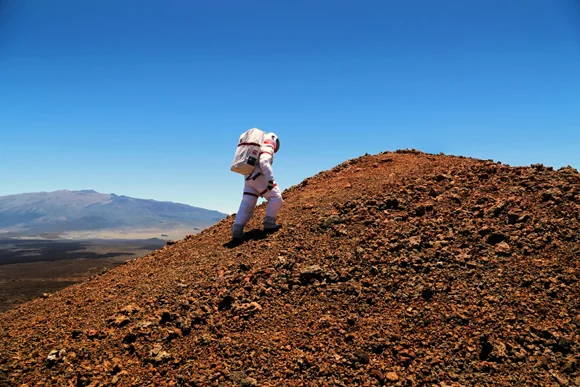
In Space, No One Can Hear Your Takeout Order
NEW YORKER | In April, six people entered a geodesic dome, just thirty-six feet in diameter, perched on the barren, reddish slopes of the Hawaiian volcano Mauna Loa. They will be there until August, simulating that they are living on Mars. Their mission: to eat.

Credit: Angelo Vermeulen
FIRST PUBLISHED IN NEWYORKER.COM, JUNE 17, 2013
IN APRIL, SIX PEOPLE entered a geodesic dome, just thirty-six feet in diameter, perched on the barren, reddish slopes of the Hawaiian volcano Mauna Loa. They will be there until August, simulating that they are living on Mars. Their mission: to eat.
While humans are decades away from potentially becoming an invasive species on Mars, it’s not too soon for NASA to think about how astronauts will feed themselves when they arrive. A question like “How much water is needed to make a beef tagine?” must be answered by engineers well in advance. Funded byNASA’s Human Research Program, the Hawaii Space Exploration Analog and Simulation’s four-month mission is to compare classic astronaut fare of pre-made, prepackaged meals to a new system that allows for combining a limited number of shelf-stable ingredients.
The crew of six terranauts, selected from a pool of seven hundred applicants, alternate between two days of prepackaged meals and two days of dome home cooking; chef duties are executed in pairs. The pantry has been stocked with ingredients like flax seeds, sourdough starter, anchovies, egg-white crystals, dried hijiki seaweed, and canned Spam—a nod to local cuisine, as well as Pacific U.S. military history. While the crew completed cooking classes at Cornell prior to entering the habitat, no member has professional culinary experience. They are relying on a cookbook and a mission-support group, which is available for twelve hours a day to hunt down online recipes and answer operational questions. (There is, however, a twenty-minute time delay between the dome and the support group, to simulate the communication gap with Mars.)
The HI-SEAS crew documents every meal meticulously, like a group of neurotic nutritionists. They record the ingredients that comprise every meal and the weight of each dish; they take photos of every plate and note any leftovers; and they fill out surveys before and after every meal, recording hunger levels, mood, productivity, and health. Sian Proctor, a geology professor who previously lived in a simulated desolate environment as one of the stars of the reality-television series “The Colony,” proclaimed that lunch on April 21st was “amazing.” It was a “Martian” sweet-and-sour-chicken-and-cabbage soup, made with dehydrated veggies and freeze-dried pineapples, and coconut bread. Other favorites have included a Thai red curry with tofu, jasmine rice, and homemade raisin bread (“so good that the crew is looking forward to testing out the green curry paste”) and Tibetan tsampa porridge.
In May, to celebrate the one-month anniversary of living in “the Hab,” as the crew calls the habitat, Yajaira Sierra-Sastre, a materials scientist, made Spam musubi. This kind of cooking has a genuine, if intangible, value, by boosting morale. The explorer “[Ernest] Shackleton, in Antarctica, went out of his way for celebratory meals,” said Kim Binsted, a project leader for HI-SEAS. “We expect that celebratory meals will be very important,” she said, recalling her own experience cooking poutine for a homesick Canadian crewmate when she lived at the Flashline Mars Arctic Research Station, another simulated Mars habitat, on Devon Island, Canada, for four months in 2007.
Yet, prepackaged meals hold an obvious appeal in space, for largely the same reason a housebound crew on Earth stocks a freezer with Hot Pockets: convenience. “Packaged foods are going to be around forever,” said Michele Perchonok, who leads NASA’s Advanced Food System team, at the Johnson Space Center, in Houston. “We’re never giving that up completely.” One ofNASA’s challenges for Mars, she explained, is to come up with pouched foods that can last for up to five years. Currently, the agency has around seven meat items with that kind of shelf life; it is striving to develop new ways of processing, packaging, and storing these foods.
The downside of relying primarily on prepackaged foods for a long-term surface mission is that they can cause a syndrome known as “menu fatigue,” a common affliction at the International Space Station. “If you have a pre-prepared lasagna, it may be very nice lasagna, but it’s only ever going to be lasagna for the rest of time,” said Binsted. The gastronomically bored astronauts end up consuming fewer calories, and, ultimately, lose weight.
The general phenomenon of astronauts losing weight in space has been well documented, but researchers are still investigating its precise causes. It is clear that something about living in space mutes the sense of taste, dulling appetites. One unproven theory, based on anecdotal evidence, is that, simply, the I.S.S. is smelly: the odor dampens astronauts’ sense of smell, which then affects their taste buds. To examine this theory, the HI-SEAS crew members on Mauna Loa are testing their sense of smell two different ways: they take scratch-and-sniff tests, which gauge the performance of their sense of smell, and odorant-I.D. tests, in which they try to identify a piece of food that is placed in a small, opaque tub by sniffing through a straw.
Another hypothesis points to microgravity, which causes fluid in the body to shift, leading to congestion. At NASA’s Flight Analog Research Unit, in Galveston, Texas, another group of volunteers is undergoing a bed-rest study while eating the same diet as the HI-SEAS crew. To simulate microgravity conditions and its fluid-shifting, muscle-atrophying effects on Earth, these less fortunate subjects will lie horizontally, with their feet slightly elevated and their heads angled down, for weeks. During the study, which will observe any changes that occur in their nasal cavities while staring at the ceiling for so long, the volunteers will be evaluated on their ability to identify odors, and they will have the flow of air through their nostrils measured.
Ultimately, the food for any future long-term surface mission, like on Mars, will most likely be supplied by a combination of the standard prepackaged-food system and a “bio-regenerative” system based on a formula that accounts for the food’s weight, volume, prep time, nutrition, and the satisfaction it delivers. A trade-off study by NASA’s Advanced Food System group tested a hundred recipes and found that having some combination of the two food systems would also be most efficient in terms of the cargo load. “When you’re talking about a Mars mission that goes two and a half years, and if you’ve got to feed a crew of six, you’re looking at around twenty-two thousand pounds of food,” said Perchonok. “About three thousand of that is packaging.” NASA could cut down on that amount if it were to send bulk ingredients, like soybeans or wheat berries, to Mars, which could then be milled into flour to make bread or pasta. But that could require bulky equipment, like an extruder—another trade-off. “This whole mix and match, we have to figure it all out,” Perchonok said.
While the HI-SEAS study will, ideally, give NASA insight into the importance of food variety and “acceptability” for the long-term goal of habitation on Mars, the results could be helpful for more immediate missions as well. “If you tell me I’m going to have meatloaf, mashed potatoes, and green beans that are prepackaged, and all I have to is hydrate it—which takes three minutes,” said Perchonok, “or I have the choice of taking some fresh vegetables out of the garden, mixing them with some tofu that I’ve made, and some packaged chicken and sauces, to make a meal—and that can take me an hour—is the time worth my effort for the quality of the food?” In some ways, these are just basic questions the fortunate among us deal with on Earth every day. But in space, takeout is not an option.